
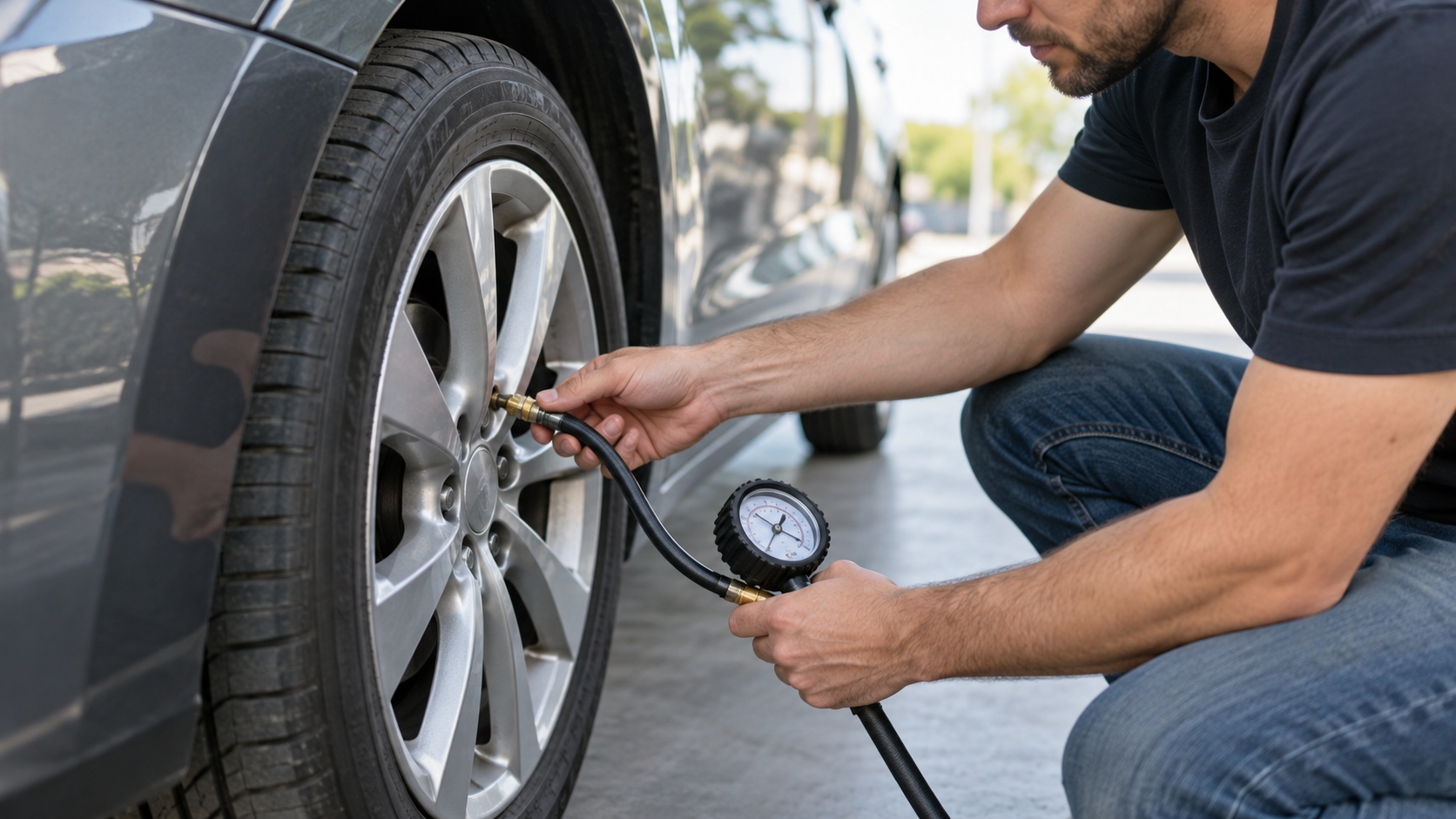
You pull into a gas station, grab the air hose, and suddenly realize there is one very basic problem: what number are you actually supposed to use?
Maybe the tire says 44 PSI on the sidewall. The pump is already showing 28 PSI. Your neighbor swears every tire should be at 35. And the dashboard has just turned on that little horseshoe-shaped warning light.
So, how much air should be in a tire?
The correct answer is surprisingly simple: use the tire pressure recommended by the vehicle manufacturer. You can usually find it on a label inside the driver’s door or door jamb. It may also appear in the owner’s manual.
For many passenger cars, recommended cold tire pressure falls somewhere around the low-to-mid 30 PSI range. SUVs, pickup trucks, performance cars, and vehicles carrying heavier loads may require something different. Front and rear pressures may also differ.
That is why there is no single PSI number that works for every vehicle.
If you arrived here after searching “how much air should be in a tire do,” the key thing to remember is this: the number on your vehicle’s tire-pressure label matters more than a random number printed on an air pump or suggested by someone in the parking lot.
Where to Find the Correct Tire Pressure
Start with the driver’s door.
Open it and look around the door jamb, door edge, or nearby body pillar. Most modern vehicles sold in the United States have a tire and loading information label in this area.
The label normally lists the original tire size and recommended cold tire inflation pressure for the front and rear tires. Some vehicles also provide information for the spare.
If you cannot find the label, check the owner’s manual.
And if the tires have been changed to a different size or type from the original equipment, things can get a little more complicated. In that case, the original placard is still the starting point, but a qualified tire professional may need to confirm the appropriate pressure for the replacement setup.
Do Not Use the Maximum PSI on the Tire Sidewall
This is probably the most common tire-pressure mistake.
Look closely at the tire sidewall and you may see a number such as 44 PSI, 50 PSI, or something similar associated with maximum load or maximum inflation pressure.
That is not automatically the pressure your car should use every day.
The tire manufacturer prints information about the tire’s capabilities on the sidewall. The vehicle manufacturer determines the pressure appropriate for that tire size on your specific vehicle, taking into account load, handling, braking, ride quality, and other design factors.
So if your door placard says 33 PSI and the tire sidewall mentions a maximum of 44 PSI, you normally follow the vehicle placard’s 33 PSI recommendation when the tires are cold.
More air is not automatically better.
| Where You See the Number | What It Usually Means | Should You Use It for Daily Inflation? |
|---|---|---|
| Driver’s door or door-jamb label | Vehicle manufacturer’s recommended cold tire pressure | Yes |
| Owner’s manual | Vehicle-specific tire pressure information | Yes |
| Tire sidewall | Tire specifications and maximum pressure/load information | Not as your default target |
| Gas-station air pump | Current measured pressure or the target you set | Only after checking the vehicle recommendation |
| Advice from another driver | A general guess based on another vehicle | No |
What Does PSI Mean?
PSI means pounds per square inch. It is the pressure unit most American drivers see when checking tires.
Some vehicles and gauges also display pressure in kilopascals, or kPa. You may also occasionally see bar, especially on equipment or vehicles designed for international markets.
You do not need to become a physics expert here. What matters is matching the unit on your gauge to the unit shown on your vehicle’s placard.
If the placard says 35 PSI, set the tire to 35 PSI when cold unless the manufacturer provides different instructions for your driving conditions or load.
What Is “Cold Tire Pressure”?
This phrase causes more confusion than it should.
Cold does not mean the tire has to feel cold to your hand. It means the tire has not been heated significantly by driving.
A good time to check is before driving for the day or after the car has been parked for several hours.
Driving heats the tires. As the air inside heats up, its pressure rises. It is completely normal for the pressure to be several PSI higher after highway driving than it was before the trip.
And that leads to an important rule: don’t let air out of a properly inflated hot tire just because the pressure has increased.
If you set a cold tire to the correct manufacturer-recommended pressure and later see a higher number after driving, the increase is expected.
How Often Should You Check Tire Pressure?
A quick visual check is not enough.
Modern radial tires can look fairly normal even when they are noticeably underinflated. By the time one looks obviously flat, the pressure may already be far below where it should be.
A reasonable routine is to check tire pressure about once a month and before longer road trips. It is also smart to check after a major temperature change.
Pay extra attention when:
- The weather suddenly becomes much colder or hotter.
- The TPMS warning light appears.
- The vehicle has been parked for a long time.
- You are preparing for a long highway trip.
- You recently hit a pothole or curb.
- One tire seems to lose pressure faster than the others.
- You are carrying an unusually heavy load and the owner’s manual provides special pressure guidance.
It only takes a few minutes, and those few minutes can tell you quite a lot about what is happening with the tires.
Why Tire Pressure Changes With Temperature
Air pressure changes with temperature. This is why the TPMS light often seems to appear on the first genuinely cold morning of fall.
A commonly used rule of thumb is that tire pressure changes by roughly 1 PSI for each 10°F change in ambient temperature. It is only an approximation, but it explains why a tire that seemed fine during warm weather can suddenly read several PSI lower after a cold front arrives.
Suppose your tires were set to 35 PSI on a warm afternoon. Several weeks later, temperatures drop sharply overnight. You might wake up to readings closer to 31 or 32 PSI even though there is no puncture.
That does not mean you should wait for spring.
Adjust the cold pressure back to the vehicle manufacturer’s recommendation.
Should Front and Rear Tires Have the Same Pressure?
Sometimes yes. Sometimes no.
Plenty of cars recommend identical pressure front and rear. Others specify something like 35 PSI in front and 33 PSI in the rear. Performance vehicles and vehicles designed to carry heavier loads can have even larger differences.
This is another reason the door-jamb label matters.
Do not automatically make all four tires identical just because that seems tidy.
The difference may be intentional.
What Happens if Tire Pressure Is Too Low?
An underinflated tire flexes more as it rolls.
That extra flex creates heat and increases rolling resistance. The tire may wear faster along the shoulders, steering can feel less precise, fuel efficiency may drop, and braking or handling behavior can change.
Severe underinflation is more serious. Heat buildup and structural stress can damage a tire, especially during prolonged highway driving.
Common signs that deserve attention include:
- A tire-pressure warning on the dashboard.
- Sluggish or heavy steering feel.
- A vehicle that pulls unexpectedly.
- A tire that looks noticeably lower than the others.
- Repeated need to add air to the same tire.
- Unusual wear along the outer edges of the tread.
- A sudden change in pressure after hitting road debris or a pothole.
If one tire is significantly lower than the other three, don’t just keep topping it off forever.
There may be a nail, screw, damaged valve stem, rim leak, bead leak, or other problem that needs repair.
What Happens if You Put Too Much Air in a Tire?
Overinflation is not the clever opposite of underinflation.
A tire filled significantly above the vehicle’s recommended pressure can ride more harshly and may have a smaller effective contact patch under certain conditions. It can also become more vulnerable to impact damage from potholes and road hazards.
Excessive pressure may contribute to uneven tread wear, often toward the center of the tire, although wear patterns can have several causes.
And no, filling a tire close to its maximum sidewall pressure is not a good trick for getting better gas mileage.
Stay with the vehicle recommendation unless the manufacturer specifies something different for a particular load or driving situation.
What if You Accidentally Overfill a Tire?
No drama needed.
If the tire is cold and you accidentally inflate it above the recommended pressure, release small amounts of air and recheck with a reliable gauge until you reach the correct PSI.
If the tire is hot after driving, remember that pressure will naturally be elevated.
Do not immediately bleed the tire down to the cold-pressure number while it is hot. You could end up underinflated once the tire cools.
How Accurate Are Gas-Station Tire Pumps?
They can be convenient, but accuracy varies.
A pump may be used hundreds of times, dropped, exposed to weather, or simply poorly calibrated.
Having your own tire-pressure gauge is useful. A basic digital gauge or good-quality pencil or dial gauge can stay in the glove box and give you a consistent reference.
If a gas-station pump says 38 PSI and your own trusted gauge says 34, that four-pound difference matters enough to investigate.
How to Check Tire Pressure Correctly
The process is easy once you’ve done it once.
- Find the recommended cold PSI on the driver’s door label.
- Check the tires before driving or after the vehicle has been parked for several hours.
- Remove the valve-stem cap.
- Press the tire-pressure gauge firmly onto the valve stem.
- Read the pressure and compare it with the placard.
- Add air in short bursts if the pressure is low.
- If you add too much, release a small amount and measure again.
- Replace the valve-stem cap when finished.
- Repeat the process on every tire.
And yes, check all four.
Drivers sometimes measure the tire with the warning and forget that the other three have been living through the same temperature changes.
What About the Spare Tire?
The forgotten fifth tire deserves attention too.
A compact temporary spare may require considerably more pressure than the regular tires. Pressures around 60 PSI are common for many compact spares, but the correct number should come from the tire, vehicle label, or owner’s manual for your specific car.
Do not assume your spare needs the same 32 or 35 PSI as the tires currently on the road.
And don’t wait for a roadside emergency to discover that your spare has been sitting at 20 PSI for three years.
Check it periodically.
How Does TPMS Work?
Most newer passenger vehicles in the United States have a Tire Pressure Monitoring System, commonly called TPMS.
Direct systems use pressure sensors associated with the wheels. Indirect systems can infer pressure differences by monitoring wheel-speed behavior through the vehicle’s existing sensors.
The warning symbol looks a bit like a flat tire with an exclamation point inside.
TPMS is useful, but it does not replace a pressure gauge.
The system is designed primarily to warn about significant underinflation, not to tell you that a tire is just two or three PSI below your preferred cold setting.
If you wait for the light before ever checking your tires, you are waiting too long.
Why Did My TPMS Light Come On When the Tires Look Fine?
Cold weather is one common explanation.
Pressure may have dropped enough to trigger the system even though none of the tires looks visibly flat.
Another possibility is a slow leak.
Check all tires with a gauge and inflate them according to the vehicle label. Depending on the vehicle, the TPMS light may go out automatically after driving, or a reset/relearn procedure may be required.
If the warning repeatedly returns, find out why.
Constantly adding air every few days is not normal maintenance.
Why Does One Tire Keep Losing Air?
A small leak does not always create a dramatic flat tire overnight.
A tiny nail can leak slowly for weeks. A valve core may leak. Corrosion where the tire meets the wheel can allow air to escape. Wheels can bend. Temperature changes can make an already marginal leak more noticeable.
If one tire consistently loses more pressure than the others, have it inspected.
Do not simply assume the tire “likes to run low.” Tires don’t have personalities, even if owning a car sometimes makes it feel that way.
Is 30 PSI Too Low?
Maybe. Maybe not.
If your vehicle calls for 30 PSI cold, then 30 PSI is correct.
If your placard calls for 36 PSI and the tire is sitting at 30 PSI, it is underinflated.
The number only makes sense when compared with the manufacturer’s specification.
This is why questions such as “Is 30 PSI safe?” cannot be answered properly without knowing the vehicle.
Is 35 PSI a Good Tire Pressure?
Thirty-five PSI happens to be close to the recommended pressure for many passenger vehicles, which is probably why people treat it as a universal number.
But there is nothing magical about 35.
Your vehicle may call for 30, 32, 33, 36, 38, 42, or something else entirely.
Read the placard.
It takes about ten seconds and ends the debate.
Typical Tire Pressure Examples
The following ranges are only general examples, not replacement specifications for your vehicle.
| Vehicle or Tire Situation | What You Might Commonly See | What You Should Actually Follow |
|---|---|---|
| Passenger sedan | Often low-to-mid 30s PSI | Vehicle door placard |
| Compact crossover | Often around the low-to-upper 30s PSI | Vehicle door placard |
| Large SUV or truck | Can vary widely based on tires and load | Vehicle label and owner’s manual |
| Performance vehicle | May specify different front/rear pressures | Manufacturer specification |
| Compact temporary spare | Often significantly higher than road tires | Spare-tire and vehicle information |
The takeaway is pretty clear: “average” pressure is useful for understanding the topic, not for setting your own tires.
Should Tire Pressure Be Higher for a Heavy Load?
Some vehicles provide different inflation instructions when carrying heavy loads, towing, or operating under specific conditions.
Do not improvise by adding 10 PSI just because the trunk is full.
Check the owner’s manual and tire-loading label.
Pickup trucks deserve special attention here because recommended pressures can depend strongly on tire type, axle load, and vehicle configuration.
What About Aftermarket Tires?
If you replace your original tires with the same size and appropriate load rating, the vehicle placard usually remains the primary reference for cold pressure.
Things become less straightforward when you change wheel diameter, tire size, load rating, construction, or intended use.
For example, someone may replace standard passenger tires with higher-load tires on a truck or install a significantly different wheel-and-tire package.
At that point, simply copying the sidewall maximum is still not the answer.
Ask an experienced tire shop to determine an appropriate pressure based on vehicle weight, tire load capacity, and the new setup.
Does Tire Pressure Affect Gas Mileage?
Yes, especially when tires are significantly underinflated.
A soft tire has greater rolling resistance because it flexes more as the vehicle moves. The engine then has to work a little harder to keep the car rolling.
Correct pressure supports fuel efficiency, but that does not mean overinflating the tires gives you a free mileage hack.
The target remains the manufacturer’s recommendation.
Does Tire Pressure Affect Tire Wear?
It can.
Chronic underinflation may contribute to heavier shoulder wear. Chronic overinflation may contribute to greater center wear.
But tire wear is not controlled by pressure alone.
Wheel alignment, suspension condition, tire rotation, driving style, vehicle load, and road conditions can all create unusual tread patterns.
If your tires are wearing unevenly despite correct pressure, don’t just keep adjusting PSI. There may be another problem.
What Tire Pressure Should You Use in Winter?
Use the vehicle manufacturer’s recommended cold pressure unless the manual gives different instructions.
The important part is checking the tires after temperatures fall.
Imagine the tires were properly set during a 75°F afternoon in early fall. A month later, morning temperatures are near freezing. The pressure may now be noticeably lower simply because the air is colder.
Bring the cold pressure back to specification.
Do not intentionally drive several PSI low all winter because you assume softer tires provide better snow traction. Proper winter traction comes from the right tire type, tread condition, and correct inflation.
What Tire Pressure Should You Use in Summer?
The same principle applies.
Set the tires to the recommended cold pressure.
Yes, tire pressure will rise as the tires heat up during a summer drive. The vehicle and tire manufacturers expect that.
Do not reduce cold tire pressure in anticipation of the afternoon heat.
Why Does Pressure Rise While Driving?
Tires flex as they roll, creating heat. Road temperature and braking can add more heat. That warms the air inside the tire, which raises pressure.
It is normal.
The recommended cold PSI already accounts for this behavior.
That is also why checking the tires after an hour on the interstate can give you a misleading number if you’re trying to set cold pressure.
Can You Drive on a Tire With Very Low Pressure?
If a tire is severely underinflated or visibly flat, continuing to drive can damage it quickly.
The sidewall may flex far beyond its intended range, creating heat and potentially causing internal damage that cannot be seen from the outside.
If a tire suddenly loses a large amount of pressure, find somewhere safe to stop.
A tire that could have been repairable after a small puncture may become unusable after being driven flat.
Do New Tires Need Different Pressure?
Normally, installing new tires of the proper original-equipment size does not mean you suddenly follow a new pressure number from the sidewall.
You generally continue with the vehicle manufacturer’s cold-pressure recommendation.
New tires may feel different because the tread is deeper and the casing characteristics differ from the worn tires you replaced. That does not automatically mean they need more or less air.
How Much Air Is Too Much?
There isn’t one universal cutoff because the correct pressure and tire limits vary.
A few PSI above the recommended cold setting because the tire warmed during driving is normal.
Deliberately filling a cold tire substantially above the manufacturer’s recommended pressure is another story.
If you discover that somebody inflated your cold tires to the maximum sidewall pressure even though the door label calls for much less, adjust them back to specification.
FAQ
How much air should be in a tire?
Use the cold tire pressure listed on your vehicle’s driver’s-door or door-jamb label. Many passenger cars are somewhere in the low-to-mid 30 PSI range, but the correct number is vehicle-specific.
Is 35 PSI too high?
Not necessarily. Thirty-five PSI is correct for many vehicles and wrong for others. Compare it with the cold-pressure recommendation on your vehicle’s tire-information label.
Should I use the PSI printed on the tire?
Do not automatically inflate the tire to the maximum pressure shown on its sidewall. For normal driving, follow the vehicle manufacturer’s recommended cold pressure unless specific instructions say otherwise.
Should all four tires have the same PSI?
Not always. Some vehicles specify different pressure for the front and rear tires. Check the door-jamb placard rather than assuming all four should match.
Should I check tire pressure when the tires are hot or cold?
Check them cold, ideally before driving or after the vehicle has been parked for several hours. Driving heats the tires and naturally raises their pressure.
Why does tire pressure drop in cold weather?
Air pressure decreases as temperature falls. A rough rule of thumb is about 1 PSI for each 10°F temperature change, though actual results vary.
How often should I check tire pressure?
About once a month is a practical routine, plus before long trips and after major temperature changes. Check sooner if the TPMS light appears or one tire seems to be losing air.
Conclusion
So, how much air should be in a tire?
Forget the universal 32 PSI rule. Forget the guy at the gas station who insists everything should be 35. And definitely don’t assume the maximum number molded into the tire sidewall is your everyday target.
Open the driver’s door.
Find the tire-information label.
Use the manufacturer’s recommended cold pressure.
That’s the number your vehicle was designed around.
For many cars, it will land somewhere in the low-to-mid 30s. But your front tires might need 33 PSI while the rears need 35. Your SUV might require something different. Your temporary spare may need dramatically more pressure than any of them.
And remember the word “cold.”
A tire set correctly in the morning will naturally show a higher pressure after an hour of highway driving. Do not bleed that extra pressure away just because the number climbed.
Temperature matters too. When autumn turns cold, tires can lose several PSI without having a puncture. Check them, adjust them, and move on.
If only one tire keeps dropping while the other three stay steady, that’s different. Look for a leak instead of treating the air pump as part of your weekly routine.
Proper pressure is one of those small car-maintenance jobs that has a surprisingly big effect. It helps tires wear normally, supports predictable steering and braking behavior, reduces unnecessary rolling resistance, and lowers the chance that you end up staring at a flat tire on the shoulder of the interstate.
You don’t need expensive equipment either.
A decent pressure gauge, access to an air pump, and about five minutes once a month will do the job.
And while you’re there, check the spare.
Because the worst possible moment to discover that your spare needed air was three years ago is when you’re standing beside a flat tire at 11 p.m.
Tire pressure isn’t complicated once you know which number matters.
The car already tells you.
You just have to open the door and look.
Leave a Reply