
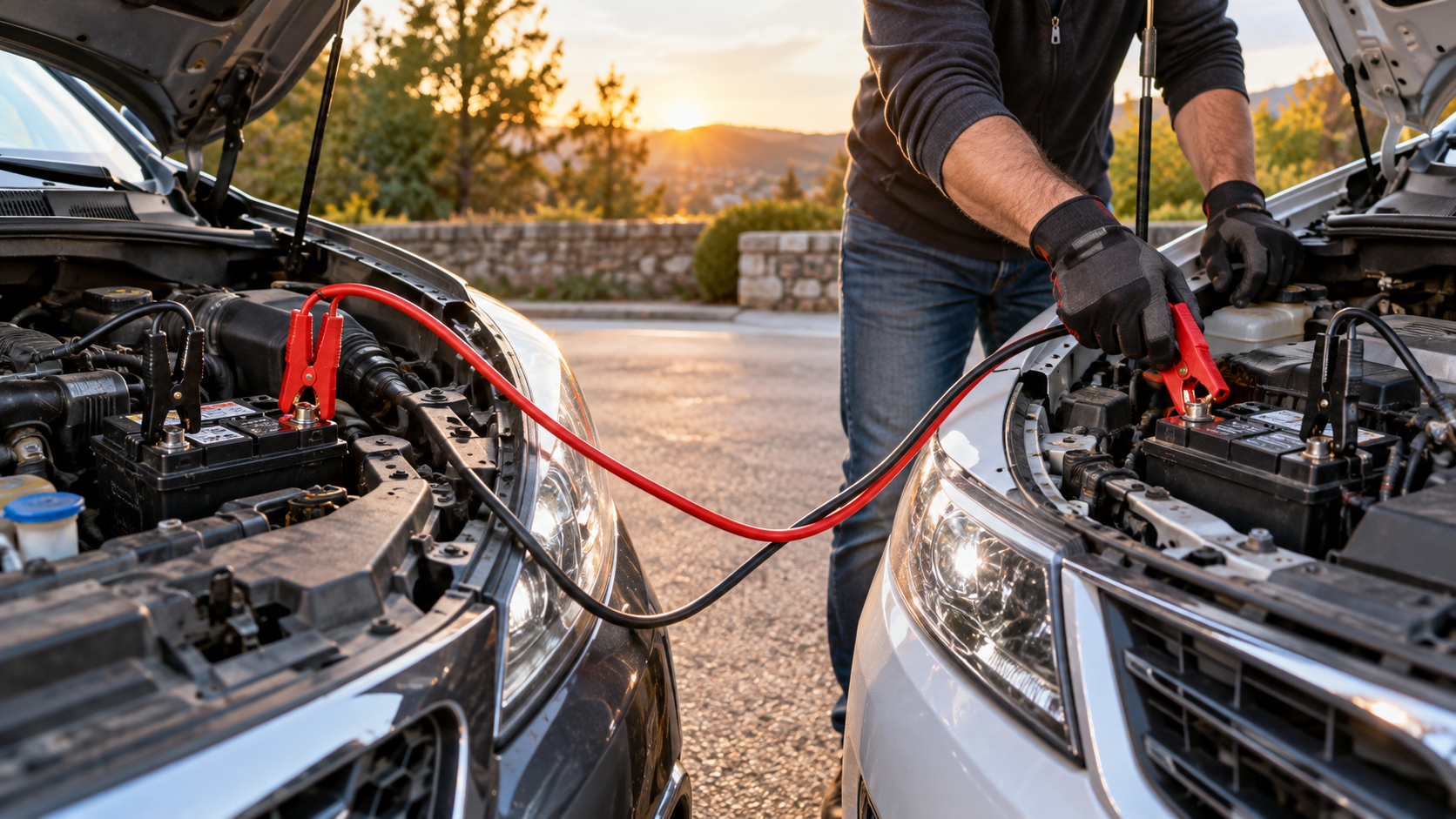
You get into the car, turn the key or press the start button, and… click. Maybe the dashboard lights flicker. Maybe you hear a rapid series of clicks. Or maybe the whole car seems strangely quiet.
A weak 12-volt battery is one of the most common reasons a gasoline or diesel vehicle suddenly refuses to start. The good news is that a jump start can often get you moving again in a few minutes.
But there is a right way to do it.
Modern cars contain far more electronics than vehicles from a few decades ago. A careless jumper-cable connection can create sparks, damage electrical components, or expose you to a battery that is already unsafe. And hybrids and electric vehicles bring another layer of rules.
So if you are wondering how to jump start a car battery, don’t start by randomly attaching red and black clamps. First, confirm that a jump start actually makes sense.
First, Make Sure the Battery Is Probably the Problem
A car that does not start does not automatically have a dead battery.
The battery’s job is to supply electrical power to the starter and the vehicle’s electronics while the engine is being started. If the battery has lost too much charge, the starter may not receive enough current to turn the engine.
Typical clues include dim dashboard lights, slow cranking, rapid clicking when you turn the key, or electronics that work until you attempt to start the engine and then suddenly fade.
A single heavy click with otherwise bright lights may point toward the starter or another electrical problem instead. And if the engine is already cranking at its normal speed but refuses to run, a jump start probably will not solve the problem.
| What Happens When You Try to Start | Possible Cause | Would a Jump Start Help? |
|---|---|---|
| Rapid clicking | Weak battery or poor battery connection | Often |
| Engine cranks very slowly | Weak battery, poor connection, starter issue | Possibly |
| Dashboard goes very dim | Battery voltage dropping under load | Often |
| One strong click | Starter, solenoid, battery cable, or battery problem | Maybe |
| Engine cranks normally but does not run | Fuel, ignition, sensor, security, or other engine issue | Usually not |
| No electrical power anywhere | Completely discharged battery, loose cable, main electrical fault | Possibly, after checking connections |
If you have a multimeter, a voltage test can provide another clue, but voltage alone does not tell the whole story. A battery may show reasonable open-circuit voltage and still fail badly under starter load.
When You Should Not Attempt a Jump Start
Before touching the cables, look at the battery.
If something seems seriously wrong, stop.
- Do not jump a visibly cracked, leaking, badly swollen, or physically damaged battery.
- Do not attempt to jump a battery that may be frozen.
- Do not proceed if you smell a strong sulfur or rotten-egg odor around the battery.
- Do not smoke or create an open flame near a vehicle battery.
- Do not let jumper-cable clamps touch each other while connected to a battery.
- Do not assume a hybrid or electric vehicle follows the same procedure as a conventional gasoline car.
- Do not connect cables until you have identified the correct positive and negative points.
A lead-acid battery can release hydrogen gas, particularly while charging. A spark near the battery can therefore be dangerous.
This is also why the final negative connection is commonly made to a designated chassis or engine ground away from the discharged battery rather than directly onto its negative terminal. Your vehicle’s owner’s manual should take priority because manufacturers may provide dedicated jump points and a specific connection sequence.
What You Need to Jump Start a Car
The traditional setup requires a working vehicle with a compatible 12-volt electrical system and a set of jumper cables.
The cables should be in good condition. Avoid using cables with damaged insulation, badly corroded clamps, exposed conductors, or loose connections.
Thicker, good-quality jumper cables generally carry starter current better than very thin bargain cables, especially when the cables are long.
An increasingly convenient alternative is a portable lithium jump starter. These small battery packs can start many passenger vehicles without a second car. They are useful if you frequently drive alone or park somewhere another vehicle cannot easily reach.
Either way, keep the owner’s manual nearby if possible.
Locate the Correct Jump-Start Points
It would be nice if every battery sat conveniently under the hood with both terminals clearly visible. Cars don’t work that way anymore.
Some batteries are in the trunk. Others sit under a seat or beneath panels. Certain vehicles have the battery in one location but provide dedicated positive and ground terminals under the hood specifically for jump starting.
If your vehicle has designated jump points, use them.
Look for a positive terminal marked with a plus sign or a red cover. The recommended ground point may be a solid unpainted metal stud, bracket, engine component, or a clearly identified terminal.
Do not guess.
Also make sure you correctly distinguish positive from negative. Reversing polarity can cause serious electrical damage.
How to Jump Start a Car Battery With Jumper Cables
The following describes a common procedure for conventional 12-volt passenger vehicles. Always check the manufacturer’s instructions first because the recommended connection locations can differ.
- Park the working vehicle close enough for the cables to reach, but do not allow the vehicles to touch.
- Place both vehicles in Park, or Neutral where appropriate, and apply the parking brakes.
- Switch both vehicles off and turn off lights, climate control, audio, heated seats, and other electrical accessories.
- Connect one red clamp to the positive terminal or positive jump point of the discharged vehicle.
- Connect the other red clamp to the positive terminal of the working vehicle.
- Connect one black clamp to the negative terminal of the working vehicle.
- Connect the remaining black clamp to the designated ground point or a solid unpainted metal part of the disabled vehicle, away from the battery and moving components.
- Check that the cables cannot contact belts, cooling fans, pulleys, or other moving parts.
- Start the working vehicle and let it run briefly.
- Try to start the disabled vehicle.
- Once it starts, allow both vehicles to run while you carefully prepare to disconnect the cables.
Do not lean directly over the battery while making connections.
And do not repeatedly crank the disabled vehicle for long periods. If it does not start after a few reasonable attempts, there may be another problem.
Which Jumper Cable Goes On First?
This is the part people tend to forget five minutes after someone explains it.
A common memory aid is positive first, ground last.
The red positive cable normally connects first. The final connection is the black cable to the ground point on the disabled vehicle.
The purpose of making that last connection away from the discharged battery is to keep the small spark that may occur during connection farther from the battery itself.
Again, follow the instructions for the actual vehicle. Some manufacturers specify dedicated remote terminals that should be used instead of the battery posts.
What Order Do You Remove Jumper Cables?
After the disabled vehicle starts, remove the cables carefully in the reverse general order.
That commonly means removing the black clamp from the previously disabled vehicle’s ground point first, followed by the black clamp from the donor vehicle, then the red clamp from the donor vehicle, and finally the red clamp from the newly started vehicle.
Keep the clamps separated while removing them.
Do not allow a connected positive clamp to swing into metal bodywork.
Once all cables are removed, close any protective terminal covers that were opened.
Should the Donor Car Be Running?
The vehicles should generally be switched off while the jumper cables are being connected.
Once all connections have been made correctly, the donor vehicle is normally started before attempting to start the disabled car.
Some vehicle manufacturers provide more specific guidance regarding engine speed, waiting time, or whether the donor engine should remain running. This is another reason the owner’s manual matters.
You do not need to rev the donor engine aggressively.
More RPM is not automatically better, and dramatic accelerator-pedal pumping is not part of a normal jump-start procedure.
How Long Should You Wait Before Starting the Dead Car?
Sometimes the disabled vehicle starts almost immediately. Other times, waiting a few minutes allows a heavily discharged battery to receive some charge from the donor vehicle.
If the dashboard was barely lighting up before the cables were connected, waiting a short period may help.
But jumper cables are not a proper battery charger.
If a severely discharged battery needs significant charging, a dedicated battery charger is a better tool.
What if You Hear Clicking but the Car Still Won’t Start?
If you still hear rapid clicking after the cables are connected, check the connections.
A clamp sitting loosely on a dirty or corroded terminal may not pass enough current to the starter.
Make sure the clamps have solid contact with clean metal.
If the connection is good and the donor battery is healthy but the vehicle still will not crank, several possibilities remain. The battery may be internally damaged, the starter may have failed, a cable may be bad, or another part of the starter circuit may have a problem.
A jump start cannot fix all no-start conditions.
What if the Car Starts and Dies Immediately?
This can happen for several reasons.
If the battery is extremely discharged and the charging system has a problem, the vehicle may not have enough electrical power to keep running.
A failing alternator is one possibility, but don’t assume that immediately. Modern charging systems can behave differently depending on vehicle design, battery condition, temperature, and electrical demand.
There can also be unrelated engine-management problems that cause the vehicle to stall.
If the car repeatedly starts only while connected to another vehicle and dies shortly after disconnection, it needs diagnosis.
How Long Should You Drive After a Jump Start?
There is no universal driving time that guarantees a discharged battery will be fully recharged.
You may hear rules such as “drive for 20 minutes” or “leave it running for half an hour.” Those can be rough suggestions, not guarantees.
Alternators are designed primarily to supply the vehicle’s electrical needs and maintain battery charge. Recharging a deeply discharged battery can take considerable time, and repeatedly relying on the alternator to recover severely discharged batteries is not ideal.
If the battery was deeply drained, charging it with a proper battery charger is usually a better way to restore it fully.
Still, if the vehicle started successfully and is running normally, avoid shutting it off immediately unless you are already somewhere safe where another start attempt will not leave you stranded.
Why Did the Battery Die?
Getting the engine running solves the immediate problem. It does not explain why the battery went dead.
Sometimes the answer is embarrassingly simple. Interior light left on. Headlights left on. Door not fully closed.
Other times, the battery is simply old and can no longer store enough energy.
Possible reasons include:
- An aging or failing battery.
- Lights or another accessory left on.
- A charging-system problem.
- Loose or corroded battery connections.
- An electrical component drawing power while the vehicle is parked.
- Long periods without driving.
- Repeated very short trips that do not restore the energy used during starting.
- Extreme heat or cold affecting an already weak battery.
If the battery dies again soon after a successful jump start, don’t make jump starting part of your morning routine. Have the battery and charging system tested.
How Old Is Too Old for a Car Battery?
Battery life varies significantly with climate, battery design, driving patterns, vehicle electronics, and maintenance.
Hot climates can be especially hard on battery chemistry even though cold weather often exposes the weakness later.
The date code on the battery may help determine its age, though manufacturers use different marking systems.
If a battery has been in service for several years and has started showing slow cranking or repeated discharge problems, testing makes sense.
Replacing a worn battery before it completely fails is usually less annoying than waiting until the car refuses to start in a supermarket parking lot.
Jump Starting With a Portable Jump Pack
A portable booster pack removes the need for a donor vehicle.
The basic principle is similar: the jump pack provides enough current to assist the vehicle’s 12-volt battery during starting.
But instructions vary between devices.
Many modern jump packs have reverse-polarity protection and indicator lights, which can make the process easier. Some require you to connect the clamps before turning the pack on. Others activate automatically.
Follow the jump pack’s instructions.
Pay attention to engine-size ratings as well. A booster designed for a small four-cylinder gasoline engine may not be suitable for a large diesel truck.
| Jumper Cables | Portable Jump Starter |
|---|---|
| Requires another suitable vehicle | Works without a second vehicle |
| Usually inexpensive | Costs more initially |
| No internal battery to recharge | Must be kept charged |
| Can deliver strong current with a capable donor battery | Output depends on the jump pack’s rating and condition |
| Requires careful cable routing between two vehicles | Compact and easier in tight parking spaces |
| Useful for most conventional roadside situations | Excellent backup for solo driving and road trips |
If you keep a jump pack in the car, check its charge periodically. Finding an empty booster next to an empty car battery is not much of a rescue plan.
Can You Jump Start a Hybrid?
Many hybrid vehicles still have a conventional 12-volt electrical system that powers computers, relays, locks, and other low-voltage equipment.
A discharged 12-volt battery can therefore prevent a hybrid from entering its ready-to-drive mode.
But the procedure is vehicle-specific.
Some hybrids have dedicated jump terminals under the hood even when the 12-volt battery is elsewhere.
Do not attempt to access or jump the high-voltage hybrid battery.
Follow the manufacturer’s procedure for your exact vehicle.
Can You Jump Start an Electric Car?
Electric vehicles also commonly have a low-voltage battery separate from the large high-voltage traction battery.
If that low-voltage battery becomes discharged, the vehicle may not wake up even when the main traction battery contains plenty of energy.
But EV jump-start procedures vary considerably.
The high-voltage traction battery is not something you should attempt to jump with standard cables.
Use only the designated low-voltage jump points and follow the vehicle manufacturer’s instructions.
Also check whether your EV is permitted to act as the donor vehicle for another car. Some manufacturers advise against it.
Can You Jump Start a Completely Dead Battery?
Sometimes.
If the battery is merely deeply discharged but otherwise healthy, a donor battery or strong booster may provide enough power to start the vehicle.
If the battery has an internal short, physical damage, a failed cell, severe sulfation, or another serious defect, a jump may not work.
A battery showing zero signs of life after correct connections deserves more investigation rather than repeated attempts.
What Happens if You Connect Jumper Cables Backward?
Reverse polarity can cause serious problems.
Depending on the vehicles involved, it can create sparks, blow fuses, damage electronic modules, damage the charging system, overheat wiring, or harm the batteries.
If you realize the cables are reversed, do not start either vehicle.
Disconnect them carefully and verify the correct positive and negative terminals before proceeding.
If a reverse-polarity connection caused heavy sparking, smoke, burning odors, or electrical problems, have the vehicle inspected.
Why the Black Cable Usually Goes to Ground
People sometimes wonder why the final black clamp does not simply connect to the negative terminal of the dead battery.
The reason is primarily spark location.
The final connection can make a small spark. Making that connection at a designated ground point away from the battery reduces the chance of creating a spark immediately next to battery gases.
It also provides a direct electrical return path through the vehicle’s engine or chassis when the manufacturer has designed the jump point that way.
Do not pick a random painted bolt. Paint can prevent good electrical contact.
What if the Battery Terminals Are Corroded?
Corrosion can create enough resistance to prevent proper starting even when the battery itself has charge.
It can also make jumper cables less effective because the clamps are not making good electrical contact.
If corrosion is severe, cleaning may be necessary before meaningful testing or jump starting can occur.
Wear eye protection and suitable gloves when working around a lead-acid battery. Battery residue can be irritating or corrosive.
If the battery case is damaged or leaking, don’t clean and continue. Replace or professionally service the battery instead.
Should You Rev the Donor Car?
Usually there is no need to aggressively rev a donor vehicle.
Running the engine normally is enough in many situations.
Some older advice recommends holding the engine at elevated RPM, but modern vehicle electronics and charging systems make broad one-size-fits-all recommendations less useful.
Follow the owner’s manual rather than improvising.
Can Jump Starting Damage the Electronics?
A correctly performed jump start using appropriate connection points is a normal emergency procedure for many vehicles.
The biggest avoidable risks come from reversed polarity, incorrect terminals, poor connections, damaged cables, or ignoring manufacturer-specific instructions.
Modern cars contain expensive computers, so “I’ve always done it this way” is not a great reason to ignore the manual.
Take the extra minute to locate the proper jump terminals.
What to Do After the Car Starts
Pay attention to how the vehicle behaves.
If warning lights remain on, the engine runs poorly, you smell burning electrical insulation, or the battery warning indicator appears, do not assume everything is fine just because the engine started.
If the original cause was simply an accidentally left-on interior light, the car may need nothing more than a proper battery recharge.
If the battery keeps going flat, testing is the next step.
A shop can check the battery’s ability to deliver starting current and inspect the charging system. If necessary, parasitic-draw testing can determine whether something continues consuming power after the vehicle is switched off.
FAQ
What is the correct order for jumper cables?
A common sequence is red to the positive point on the dead vehicle, red to positive on the donor vehicle, black to negative on the donor, then black to a designated ground point on the disabled vehicle. Check the owner’s manual because connection points can vary.
How long should I leave jumper cables connected before starting?
A mildly discharged battery may start quickly. A deeply discharged one may benefit from several minutes of connection before another start attempt. Jumper cables are not a replacement for a proper battery charger.
Can I jump start a car in the rain?
Light rain does not automatically make a normal 12-volt jump start impossible, but slippery conditions and water around electrical equipment add practical risks. Keep equipment and connections under control, and avoid working in severe weather or standing water.
Why is my car still clicking after I connected jumper cables?
The cable connections may be poor, the donor battery may be weak, the discharged battery may have an internal failure, or the starter circuit may have another problem. Check the connections before making repeated attempts.
Will driving recharge my battery after a jump?
Driving can restore some charge, but there is no fixed driving time that guarantees a deeply discharged battery will be fully recharged. A dedicated charger is a better option when the battery has been significantly drained.
Can I use any car to jump start another car?
No. The electrical systems must be compatible, and some hybrid or electric vehicle manufacturers restrict using their vehicles as donors. Always check both vehicles’ manuals before connecting them.
Why did my battery die again the next day?
The battery may be worn out, the charging system may not be working correctly, or the vehicle may have an electrical draw while parked. Repeated battery failure calls for testing rather than another series of jump starts.
Conclusion
Knowing how to jump start a car battery is one of those basic driving skills you may not need for years – until suddenly you really need it.
The process itself is not complicated. The important part is doing it carefully.
First, make sure a weak battery actually fits the symptoms. Rapid clicking, slow cranking, and lights that dim heavily during a start attempt all make battery trouble more likely.
Then inspect the battery. If it is cracked, leaking, swollen, frozen, or giving off a strong sulfur smell, do not attempt a normal jump start.
If everything looks safe, identify the correct terminals or dedicated jump points. Connect the positive side first and make the final negative connection to the manufacturer’s recommended ground point. Keep the cables away from belts and fans, and never let connected clamps touch one another.
Once the car starts, disconnect carefully in the recommended reverse order.
And here’s the part that matters after the little roadside victory: figure out why the battery went dead.
Maybe someone left a light on. Fine. That happens.
But if the battery has needed two or three jump starts recently, the car is trying to tell you something. The battery may be aging. A cable may be loose. The charging system may have a fault. Or an electrical component may be draining the battery while the car is parked.
A jump start gets you out of the parking lot. It doesn’t diagnose the vehicle.
For road trips, winter driving, or anyone who regularly parks away from home, keeping quality jumper cables or a charged portable jump pack in the car is a smart bit of preparation.
Just don’t forget the most useful tool of all: the owner’s manual.
With modern cars, the safest jump point isn’t always sitting right there on top of the battery. Taking sixty seconds to check the correct procedure can save you from turning a dead-battery inconvenience into an expensive electrical repair.
Leave a Reply