
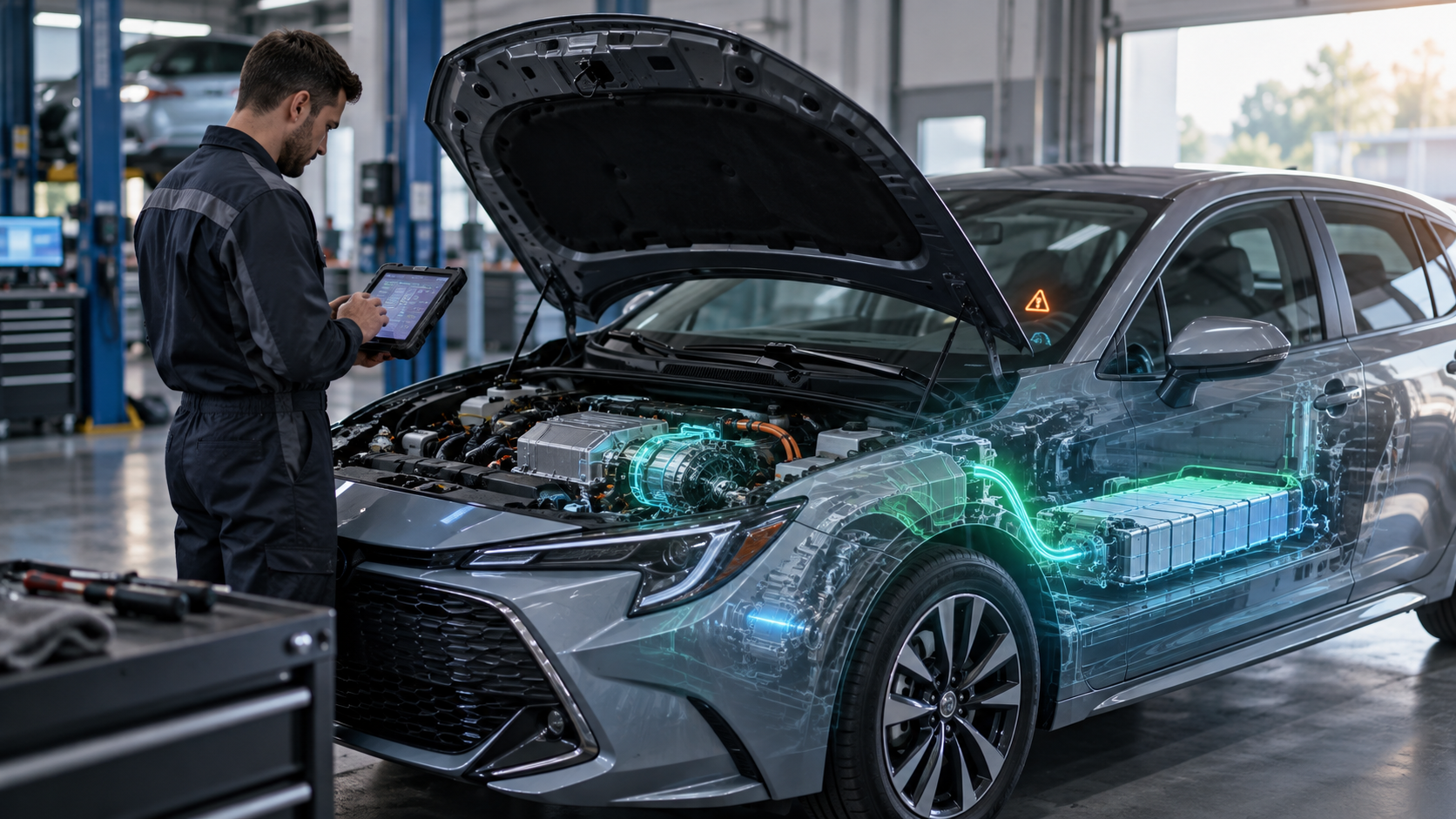
You start your hybrid, glance at the dash, and there it is: hybrid system malfunction. Sometimes the car still drives normally. Sometimes it suddenly feels weak, refuses to enter its normal ready mode, or lights up the dashboard like a Christmas tree.
That is an uncomfortable message because “hybrid system” sounds expensive. Traction battery? Inverter? Electric motor? Something buried deep inside the car?
Maybe. But not necessarily.
A hybrid system malfunction warning is broad. It can appear when the vehicle detects a problem anywhere in the network of systems that allows the gasoline engine and electric drive components to work together. Depending on the vehicle, the trigger may be as significant as a high-voltage battery fault or as ordinary as a weak 12-volt battery, cooling issue, sensor problem, wiring fault, or engine-related trouble that affects hybrid operation.
The tricky part is that the dashboard message alone usually cannot tell you which one it is.
So the first rule is simple: don’t panic, but don’t ignore it either.
What Does “Hybrid System Malfunction” Actually Mean?
A hybrid vehicle combines several systems that a conventional gasoline car either does not have or does not use in the same way.
There is still an internal-combustion engine in most hybrids. But there may also be one or more electric motor-generators, a high-voltage traction battery, an inverter or power-control unit, control modules, cooling systems, relays, high-voltage cables, and a conventional low-voltage electrical system.
These pieces constantly communicate.
If one component reports information that does not make sense, overheats, loses voltage, develops an electrical fault, or stops responding, the car may protect itself by displaying a hybrid warning and changing how the powertrain operates.
That is why two drivers can see almost the same warning and have completely different repair bills.
| What You Notice | Possible Area to Investigate | How Urgent It May Be |
|---|---|---|
| Hybrid warning but car drives normally | Sensor, 12V battery, stored fault, cooling or electrical issue | Needs diagnosis soon |
| Reduced power | Hybrid battery, inverter, engine, cooling, control-system fault | High priority |
| Vehicle will not enter Ready mode | 12V battery, hybrid interlock, traction battery, control-system problem | Do not keep forcing start attempts |
| Warning plus overheating message | Engine or hybrid-component cooling system | Stop when safe and investigate |
| Warning after sitting for days | Low 12V voltage is one possibility | Test before replacing hybrid parts |
| Warning plus burning smell or smoke | Electrical or mechanical fault | Stop driving immediately |
Think of the warning as the car saying, “Something involved in hybrid operation is outside the range I expect.” It is not a diagnosis by itself.
Can You Keep Driving With a Hybrid System Malfunction?
Sometimes the vehicle can still move. That does not mean continuing a long trip is a good idea.
If the car drives normally, temperatures look normal, there are no unusual smells or sounds, and the warning is not accompanied by a red stop message, you may be able to drive a short distance to a safe place or repair shop.
But conditions matter.
Stop driving and arrange assistance if you notice:
- Severe loss of power or inability to maintain normal road speed.
- Smoke, electrical burning odor, or a strong unusual chemical smell.
- A red temperature or stop warning.
- Repeated stalling or failure to enter Ready mode.
- Grinding, harsh mechanical noise, or obvious coolant loss.
- A message specifically telling you to stop the vehicle.
- Any sign that the car behaves unpredictably when accelerating or braking.
A hybrid can sometimes switch into a reduced-power or protective mode. That is useful because it may allow the car to move away from traffic. It should not be treated as permission to keep driving for another week.
Could It Just Be the 12-Volt Battery?
Yes, and this surprises many hybrid owners.
Most hybrids still have a conventional low-voltage battery. It may not crank a traditional starter motor in the same way as a normal gasoline car, but it powers control modules, relays, computers, locks, and the electronics required to bring the high-voltage system online.
If that 12-volt battery becomes weak, the car’s computers can behave strangely.
You might see several warning lights at once. Systems that appear unrelated may report faults. The car may refuse to enter Ready mode even though the high-voltage traction battery has plenty of energy.
A weak 12-volt battery is especially worth checking when the vehicle has sat unused, has been driven only on short trips, has recently experienced cold weather, or still has an older original battery.
But here’s the nuance: low 12-volt voltage can create confusing warnings, yet it should not automatically be blamed for every hybrid fault.
Test it.
Guessing is how people end up replacing a battery and discovering the warning is still there.
High-Voltage Battery Problems
The traction battery is the component most people immediately worry about.
Hybrid batteries consist of many cells or modules managed as a group. The battery-management system monitors voltage, temperature, state of charge, and other operating conditions.
As a hybrid ages, individual sections of the battery can become less balanced. One group may charge or discharge differently from the others. Internal resistance can rise. Temperature behavior may change.
When the control system decides those differences exceed its acceptable range, it can store diagnostic trouble codes and limit hybrid operation.
Symptoms may include frequent swings in the displayed battery charge level, reduced electric assistance, increased gasoline-engine operation, lower fuel economy, reduced power, or a hybrid warning.
Still, do not diagnose the traction battery from a dashboard message alone.
A proper scan can identify whether the fault is actually related to battery blocks, cooling, isolation, voltage sensing, communication, or something elsewhere in the vehicle.
Hybrid Battery Cooling Can Be Part of the Problem
Heat is not the battery’s friend.
Many hybrid vehicles use a fan and air ducts to control traction-battery temperature. Depending on the model, the intake may be located near a rear seat, side trim panel, cargo area, or another part of the cabin.
Dust, pet hair, luggage, blankets, or debris can restrict airflow.
That does not mean every blocked vent immediately destroys a hybrid battery. But poor cooling can make temperature management harder and may contribute to faults or accelerated battery wear.
If your owner’s manual identifies a hybrid-battery air intake, keep that area unobstructed.
And if a cooling fan needs deeper cleaning, remember that the battery compartment may be close to high-voltage components. This is one of those situations where knowing when to stop a DIY job matters.
The Inverter and Power Electronics
The inverter is one of the key pieces of a hybrid drivetrain.
In simple terms, it manages electrical power between the traction battery and the electric motor-generators. Hybrid designs differ, but the power electronics may convert voltage and change direct current into the type of current required by the motors.
That work creates heat.
Many hybrids have a dedicated cooling circuit for the inverter or power-control electronics. If coolant is low, a pump fails, circulation stops, or a temperature sensor detects excessive heat, the car may display a hybrid-system warning and reduce output.
This is why checking fluid levels can sometimes provide useful clues.
But do not open a cooling system when it is hot. And do not assume every coolant reservoir serves the same system. Hybrids can have multiple cooling circuits.
Check the owner’s manual before adding anything.
Engine Problems Can Trigger a Hybrid Warning Too
This sounds odd at first. If the message says hybrid, why would the gasoline engine matter?
Because the engine is part of the hybrid powertrain.
If the engine cannot produce the power the control system expects, hybrid operation can be affected. Misfires, air-fuel problems, sensor faults, fuel-delivery issues, or other engine-management problems may cause multiple warnings.
In some cases, the check-engine light appears alongside the hybrid warning.
That combination is useful because it tells the technician not to look only at high-voltage hardware.
A failing conventional engine component can make an otherwise healthy hybrid system seem unhappy.
What About the Check Engine Light?
If the check-engine light appears at the same time, diagnostic trouble codes become especially valuable.
A generic OBD-II scanner may read basic engine and emissions-related codes, but many inexpensive readers cannot access all hybrid-control, battery, brake, body, or manufacturer-specific modules.
That matters.
A scan tool may say there are no standard engine codes while the hybrid-control computer is storing several important faults.
For a meaningful diagnosis, the tool must be able to communicate with the relevant systems in that particular vehicle.
Common Reasons a Hybrid Warning Appears
There is no universal list because hybrid architectures vary among Toyota, Lexus, Honda, Ford, Hyundai, Kia and other manufacturers. Still, several broad categories appear again and again.
- Weak or failing 12-volt battery.
- High-voltage traction-battery deterioration or imbalance.
- Hybrid-battery cooling fan or airflow problem.
- Inverter, converter, or power-control fault.
- Hybrid cooling-system problem.
- Engine-management or emissions-related fault.
- Electrical connector, wiring, ground, or communication issue.
- Temperature, current, voltage, or position-sensor fault.
- High-voltage isolation or interlock problem.
- Stored fault after another system temporarily operated outside its expected range.
This is exactly why replacing the most expensive component first is a bad strategy.
Can the Warning Appear After a Battery Replacement?
It can.
Disconnecting or replacing a 12-volt battery may reset learned values, clocks, windows, steering-angle information, or other settings depending on the vehicle.
If the replacement battery is undercharged, connected poorly, or the terminals are loose, low-voltage problems can also continue.
On the other hand, replacing the 12-volt battery does not erase a genuine high-voltage fault.
If the hybrid system malfunction message returns after the new battery is installed, scan the vehicle instead of repeatedly disconnecting the battery in the hope that the warning disappears.
Can You Reset a Hybrid System Malfunction?
A warning light can sometimes disappear after a temporary condition is gone. Disconnecting a battery may also clear certain stored information on some vehicles.
Neither approach is the same thing as repairing the cause.
If the fault is still present, the warning will usually return.
And clearing codes before recording them can remove clues that would have helped diagnose an intermittent problem.
That is why reading and documenting trouble codes before resetting anything is usually smarter.
What You Can Safely Check at Home
You do not need to touch the high-voltage system to gather useful information.
Start with the ordinary stuff.
- Confirm whether the vehicle enters Ready mode normally.
- Look for other warning lights or messages on the dashboard.
- Check the 12-volt battery for obvious loose or corroded terminals if it is safely accessible.
- Check visible coolant levels only when the vehicle is cold and according to the owner’s manual.
- Make sure any identified hybrid-battery cooling intake is not covered.
- Notice whether the warning appeared after a long period of parking, extreme weather, repair work, or a battery discharge.
- Listen for unusual cooling-fan noise, mechanical noise, or repeated relay clicking.
- Record diagnostic codes before anyone clears them.
That is already useful information for a technician.
You do not need to dismantle the traction battery to be helpful.
What You Should Not Touch
Hybrid vehicles contain components that can operate at potentially lethal voltage.
Orange cables and connectors generally identify high-voltage circuits, although exact markings vary by vehicle.
Do not unplug them.
Do not open a high-voltage battery case. Do not probe hybrid terminals with an ordinary multimeter unless you are trained and equipped for high-voltage automotive work. Do not remove service plugs just because a video makes the job look simple.
The absence of engine noise does not mean a hybrid is electrically safe.
A hybrid can start its gasoline engine automatically when it is in Ready mode.
If the car needs high-voltage inspection or repair, that is professional territory.
Why a Hybrid Can Feel Different When Something Goes Wrong
A conventional gasoline car generally has one main source of propulsion.
A hybrid has at least two.
The computer constantly decides how much work should come from the engine, how much should come from the electric motor, and when energy should be recovered during deceleration.
If part of that system is unavailable, the car may alter its strategy.
You may notice the gasoline engine running more often, little or no electric-only operation, slower acceleration, weaker regenerative braking, or unusual changes in battery charge level.
These symptoms are useful, but they are not enough to identify the failed component by themselves.
What Does Reduced Power Mean?
Reduced power is often a protective response.
If a control module sees temperature, voltage, current, or another operating value outside its safe range, it may limit power rather than allowing the driver to continue placing heavy demand on the system.
That can feel like the accelerator has suddenly become lazy.
The car still moves, but acceleration is weaker.
If this happens on a highway, concentrate first on getting somewhere safe. Do not keep pushing the vehicle hard in an attempt to “clear it out.”
A warning accompanied by reduced power deserves prompt diagnosis.
Can Cold Weather Cause a Hybrid System Malfunction?
Cold weather can expose weaknesses that were already developing.
The low-voltage battery produces less available power in cold conditions. Battery chemistry in the traction pack is also affected by temperature, and the hybrid system may change its operating strategy until components warm up.
A healthy vehicle should still manage normal cold-weather operation.
So when a warning repeatedly appears on cold mornings, don’t dismiss it as “just winter.”
Test the 12-volt battery and retrieve codes.
Can Hot Weather Cause Hybrid Problems?
Heat can matter too.
Traction batteries, power electronics, and engine components all generate heat during operation. Cooling systems are therefore essential.
If a fan becomes clogged, airflow is blocked, coolant circulation is poor, or a pump starts failing, a problem may become more obvious during a hot day, long climb, heavy traffic, or extended highway drive.
That pattern can be diagnostically useful.
A fault that appears only after 45 minutes of driving is different from one that shows up immediately after the car has sat overnight.
Does a Hybrid System Malfunction Mean the Hybrid Battery Is Dead?
No.
This is probably the most important misconception to clear up.
The message tells you the vehicle has detected a fault affecting hybrid operation. It does not automatically identify the traction battery.
The high-voltage battery might be involved. So might the cooling system, an engine sensor, a low-voltage power problem, inverter electronics, wiring, a communication network, or another control component.
Diagnosis should come before expensive parts.
What a Proper Diagnostic Process Looks Like
A professional diagnosis should begin with information, not replacement.
The technician will typically inspect the warning history, read trouble codes from relevant modules, look at live data, test the 12-volt system, and inspect components connected to the stored faults.
For battery-related codes, that may include comparing battery-block voltage and temperature data.
For cooling faults, coolant circulation, fan operation, temperature readings, or pump commands may need to be checked.
For electrical faults, wiring diagrams and voltage-drop testing can matter more than visual inspection.
The exact process changes with the vehicle and trouble codes.
| Diagnostic Step | Why It Matters |
|---|---|
| Scan all relevant modules | Finds hybrid-specific faults that a simple engine-code reader may miss |
| Test 12V battery and connections | Rules out low-voltage problems that can confuse multiple modules |
| Review freeze-frame and live data | Shows conditions present when the fault occurred |
| Inspect cooling operation | Helps identify overheating, blocked airflow, pump, or fan problems |
| Check wiring and connectors | Finds damaged circuits or communication problems |
| Perform manufacturer-specific tests | Confirms the suspected component before replacement |
Can an Ordinary Mechanic Work on a Hybrid?
For ordinary jobs such as tires, conventional brakes, some suspension work, engine oil, and certain 12-volt electrical repairs, many general repair shops can service hybrids.
High-voltage work is different.
The shop needs technicians trained for hybrid or EV electrical safety, suitable insulated tools, protective equipment, and access to correct diagnostic information.
If the diagnosis points toward the traction battery, inverter, high-voltage cable, electric drive unit, or another energized hybrid component, ask whether the shop routinely performs that type of work.
Experience matters here.
How Much Can a Hybrid System Repair Cost?
The range is enormous because the warning can represent so many different faults.
A loose low-voltage connection may be inexpensive to correct.
A failed 12-volt battery is a routine repair.
A sensor, pump, cooling fan, or wiring repair sits somewhere else entirely.
A high-voltage battery or major power-electronics component can be much more expensive.
So there is little value in trying to estimate the repair bill from the dashboard message alone.
The useful number comes after diagnosis.
Does the Whole Hybrid Battery Always Need Replacement?
Not always, but the correct repair depends on battery design, condition, vehicle age, available parts, warranty coverage, and local repair options.
Some battery problems may be addressed with a complete new or remanufactured pack. Certain specialists perform module-level repairs on some designs.
A cheap partial repair can be tempting, especially on an older vehicle, but it may not restore all battery sections to equal health.
Ask what is being replaced, what testing was performed, what warranty is included, and whether the remaining battery modules were evaluated.
What if the Warning Disappears by Itself?
Still pay attention.
Intermittent faults matter.
A connector may lose contact only when hot. A pump may stop working occasionally. A battery block may show excessive voltage difference only under high load. A weak 12-volt battery may create low-voltage faults only after the car sits overnight.
The warning disappearing does not prove the problem repaired itself.
Diagnostic trouble codes may remain stored and can help identify what happened.
FAQ
Can I drive with a hybrid system malfunction warning?
Possibly for a short distance if the vehicle behaves normally and no stop, temperature, smoke, burning smell, or major power-loss warning is present. If the car has severe reduced power or tells you to stop, pull over safely and arrange assistance.
Does hybrid system malfunction mean the battery is bad?
No. The traction battery is one possibility, but the message can also result from low 12-volt voltage, inverter problems, cooling faults, engine issues, wiring, sensors, or communication errors.
Can a weak 12V battery cause a hybrid warning?
Yes. Hybrids depend on their low-voltage battery to power control electronics and bring the high-voltage system online. Low voltage can produce multiple warnings or prevent the vehicle from entering Ready mode.
Can I reset the hybrid warning by disconnecting the battery?
The warning may disappear temporarily, but disconnecting the battery does not repair an active fault. It can also erase useful diagnostic information. Reading the stored codes first is usually more helpful.
Can I repair a hybrid system myself?
Basic low-voltage checks may be reasonable for an experienced owner, but high-voltage components require specialized training and safety equipment. Do not open the traction battery or work on orange high-voltage cables without proper qualifications.
Why does my hybrid lose power when the warning appears?
The control system may intentionally reduce output when it detects a condition that could damage the battery, power electronics, engine, or electric-drive components. Reduced power should be treated as a sign that diagnosis is needed soon.
Will a normal OBD2 scanner show a hybrid system fault?
It may show some related engine codes, but basic scanners often cannot access every hybrid, battery, brake, or manufacturer-specific control module. A hybrid-capable diagnostic tool provides much more useful information.
Conclusion
A hybrid system malfunction warning sounds dramatic, but it does not automatically mean the most expensive part of the car has failed.
It means the vehicle detected something that is interfering with normal hybrid operation.
That “something” can range from a tired 12-volt battery to a traction-battery problem, inverter fault, cooling issue, engine-management problem, sensor failure, wiring defect, or communication error.
The dashboard message is the starting point, not the answer.
If the vehicle still drives normally, pay attention to every other clue. Did the warning appear after the car sat for a week? Did it happen during a heat wave? Does the gasoline engine now run constantly? Is the battery gauge moving unusually fast? Did the check-engine light come on too?
Those details matter.
If the car loses power, overheats, produces smoke, smells electrical, or displays a stop-driving message, treat the situation more seriously and get somewhere safe.
And resist the temptation to start unplugging hybrid components at home.
The high-voltage side of a hybrid is not comparable to replacing a conventional 12-volt battery. Orange cables, traction-battery assemblies, inverters, and related hardware require the right training and safety procedures.
The sensible order is much less dramatic: document the warning, check obvious low-voltage issues, keep battery cooling vents clear, scan all relevant control modules, and diagnose the stored codes before replacing anything.
That approach can also save money.
Replacing a traction battery because the dashboard says “hybrid system malfunction” is a bit like replacing an entire engine because the check-engine light came on. Sometimes the major component really is the problem. Plenty of times, it isn’t.
Get the data first.
And if your hybrid has already started acting differently – reduced power, strange battery-charge swings, repeated warnings, overheating messages, or refusal to enter Ready mode – don’t wait for a small intermittent fault to become the morning when the car simply will not move.
A hybrid system is complicated behind the scenes, but the owner’s response does not need to be. Notice the symptoms, avoid the high-voltage hardware, and get the right diagnosis before anyone starts ordering expensive parts.
Leave a Reply