
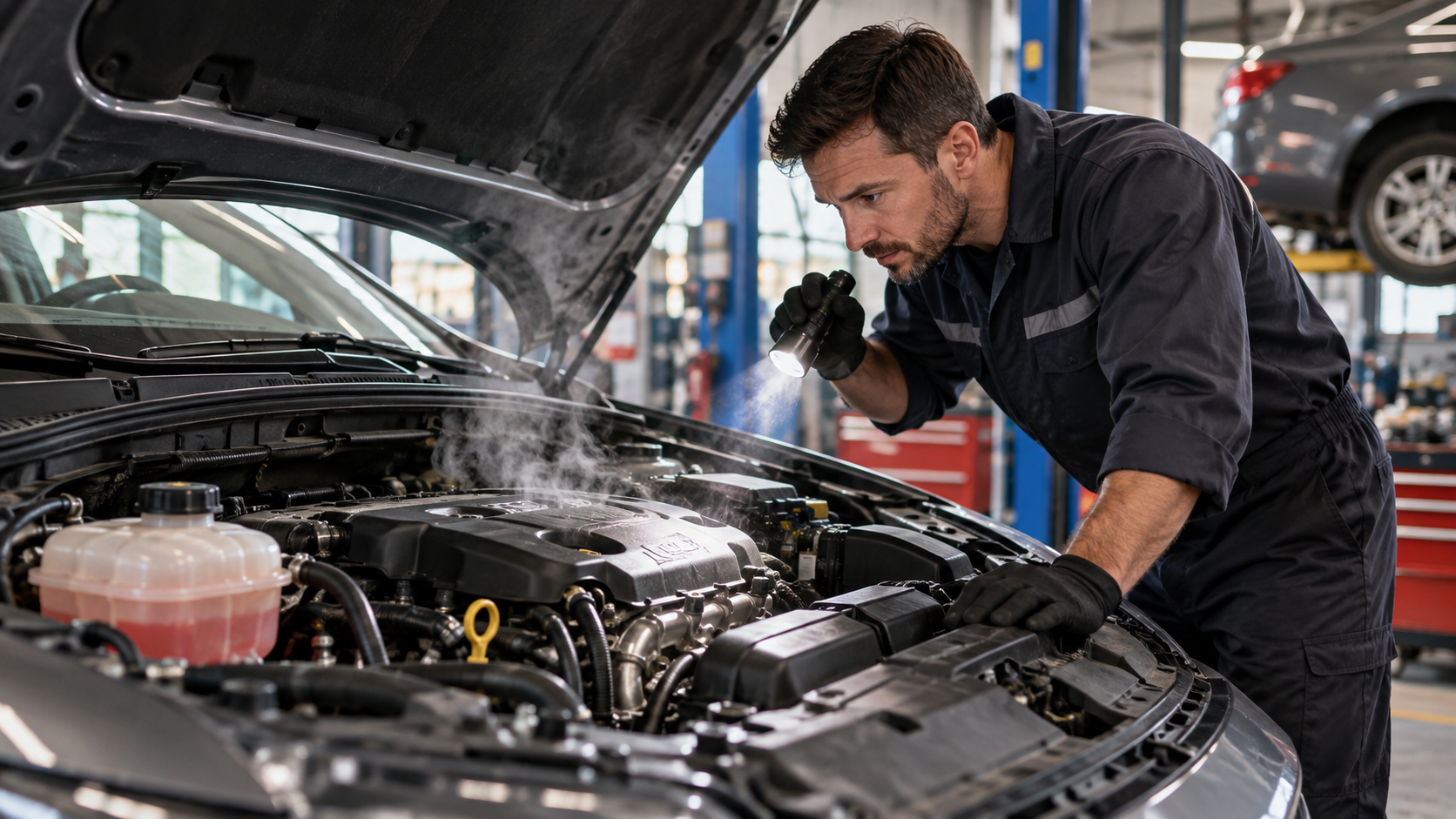
A little white smoke. A temperature gauge that suddenly climbs. Coolant that keeps disappearing even though you cannot find a puddle under the car. None of these automatically means your head gasket has failed.
But put several of them together and, yeah, it gets more interesting.
The head gasket sits between the engine block and cylinder head. Its job sounds simple: seal combustion pressure inside the cylinders while keeping engine oil and coolant flowing through their own passages without mixing together.
That seal has to survive heat, pressure, vibration, and thousands of heating and cooling cycles. When it fails, combustion gases, coolant, and oil can start traveling where they do not belong.
If you landed here after searching for “signs of a blown head gasket do,” you’re probably trying to figure out whether the strange things your car is doing point to this particular problem. The answer usually comes from a pattern of symptoms, not one dramatic clue.
And there is an important point right away: several problems can imitate a bad head gasket. A leaking radiator, failed thermostat, worn water pump, cracked hose, bad ignition coil, intake-gasket leak, or even condensation from the exhaust can create similar symptoms.
So don’t condemn the engine before testing it.
What Exactly Is a Head Gasket?
The head gasket is a thin but highly engineered seal located between the engine block and cylinder head.
Inside that small space, several different jobs are happening at once.
The gasket seals the combustion chambers so the engine can build compression. It also seals coolant passages that carry heat away from the cylinders and oil passages that lubricate parts in the cylinder head.
Those fluids are supposed to stay separate.
When part of the gasket loses its seal, the exact symptoms depend on where the failure occurs.
A leak between a cylinder and coolant passage may push combustion gases into the cooling system. A leak between oil and coolant passages can contaminate one fluid with the other. A failure between two neighboring cylinders can cause compression loss and misfires without immediately producing obvious coolant contamination.
That is why no two blown head gaskets look exactly the same.
The Most Common Signs of a Blown Head Gasket
Some symptoms are fairly subtle. Others make the car almost impossible to ignore.
- Persistent engine overheating or repeated temperature spikes.
- White exhaust smoke or steam after the engine has fully warmed up.
- Coolant loss with no obvious external leak.
- Continuous bubbles in the coolant reservoir or radiator.
- Milky, tan, or creamy contamination in engine oil.
- Oil contamination inside the cooling system.
- Rough running, misfires, or difficult cold starts.
- Loss of engine power or poor compression.
- Cooling-system hoses becoming unusually hard soon after startup.
- A sweet smell from the exhaust caused by coolant entering the combustion chamber.
One symptom alone may have a completely different explanation. Three or four appearing together deserve serious attention.
Engine Overheating Is Often the First Big Clue
Overheating is one of the classic symptoms associated with head-gasket failure.
But there is a chicken-and-egg problem here.
Sometimes a failed head gasket causes the engine to overheat. Other times the engine overheats first because of a cooling-system problem, and the excessive temperature damages the head gasket.
Either way, repeated overheating should never be treated as normal.
If combustion pressure escapes through a damaged gasket into the cooling system, it can create air pockets and interfere with coolant circulation. The cooling system may become overpressurized. Coolant can be pushed out of the reservoir. The heater may suddenly blow cold air because coolant flow becomes inconsistent.
The temperature gauge may climb during highway driving, heavy acceleration, or while sitting in traffic.
Then it drops again.
Then it climbs.
That unpredictable behavior is often what gets the driver’s attention.
White Exhaust Smoke: Normal Condensation or Coolant?
White vapor coming from the exhaust does not automatically mean a blown head gasket.
On a cold morning, especially in humid weather, visible water vapor from the exhaust is completely normal. Gasoline combustion naturally produces water, and condensation forms in a cold exhaust system.
Normal condensation usually becomes much less noticeable after the engine warms up.
Coolant burning inside the engine is different.
The exhaust may remain thick and white after the engine reaches operating temperature. It may have a sweet smell. You may also notice the coolant level slowly dropping.
That combination matters much more than white exhaust alone.
Why Does Coolant Disappear Without a Visible Leak?
This one makes people crazy.
You fill the reservoir to the proper mark. A week later, it is low again. The driveway is dry. The hoses look fine. Nothing is dripping from the radiator.
Where did the coolant go?
If the head gasket allows coolant into a cylinder, the engine can burn it and send it out through the exhaust. A smaller internal leak may consume coolant slowly enough that you never see clouds of smoke.
Coolant can also enter the oil system or escape from an external part of the head-gasket sealing surface.
But don’t jump directly to the worst conclusion. Slow coolant loss can also come from a radiator cap, water pump, heater core, plastic coolant flange, expansion tank, hose connection, or tiny radiator leak that appears only when the system is hot and pressurized.
A proper cooling-system pressure test is useful here.
Bubbles in the Coolant Reservoir Can Be a Warning
A few bubbles immediately after coolant service may simply mean trapped air is leaving the cooling system.
Constant bubbling is another story.
If combustion gases are leaking from a cylinder into the cooling system, they can produce a steady stream of bubbles in the expansion tank or radiator.
The bubbles may increase when the engine is revved.
You might also notice coolant suddenly rising or being pushed out of the reservoir.
Technicians often confirm this suspicion with a chemical combustion-gas test rather than relying only on what they see.
Milky Oil: One of the Most Famous Symptoms
People often associate a blown head gasket with beige, creamy, or “milkshake” oil.
That happens when coolant mixes with engine oil.
Pull the dipstick and you might see oil that looks unusually light, cloudy, or thick. Remove the oil cap and you may see tan sludge underneath.
Sounds decisive, right?
Not always.
A small amount of creamy residue under the oil cap can appear in vehicles driven mostly on short trips, particularly in cold weather. Moisture can condense inside the engine and mix with oil vapor before the engine spends enough time fully warm to evaporate it.
So the location and amount matter.
If the dipstick itself shows contaminated oil, the oil level is rising, coolant is disappearing, and the engine is overheating, the situation is far more concerning.
What Oil and Coolant Contamination Can Look Like
| What You Notice | Possible Meaning | How Concerning Is It? |
|---|---|---|
| Small tan residue under oil cap only | Could be condensation from short trips | Needs context |
| Milky oil on dipstick | Possible coolant contamination | High concern |
| Oil film floating in coolant reservoir | Oil may be entering cooling system | High concern |
| Coolant level falling with no external leak | Possible internal leak | Needs diagnosis |
| Oil level suddenly rising | Another fluid may be entering crankcase | Stop and investigate |
Coolant in engine oil is particularly serious because contaminated oil may not lubricate bearings properly.
Continuing to drive can turn a gasket problem into major engine damage.
Can a Blown Head Gasket Cause a Misfire?
Yes.
If coolant leaks into a cylinder while the engine sits, that cylinder may misfire badly for the first few seconds after startup.
Drivers sometimes describe it like this: the engine shakes when started cold, then gradually smooths out.
The leaking coolant may burn away and the cylinder begins firing normally again.
A larger leak can cause a persistent misfire.
A gasket failure between two cylinders can also reduce compression in both cylinders. The result may be low power, rough running, a flashing check-engine light, or stored misfire codes.
But misfires have many much more common causes, including spark plugs, ignition coils, fuel injectors, vacuum leaks, and compression problems unrelated to the head gasket.
This is where testing earns its keep.
Why the Engine May Be Hard to Start
A leaking cylinder may fill with a small amount of coolant after the engine is shut off.
On the next startup, that cylinder has to clear the liquid before combustion becomes stable.
You may notice extended cranking, rough idle, white exhaust, or a brief misfire.
In a severe case, enough liquid can enter a cylinder to prevent the piston from moving normally. Liquid does not compress like air, so this situation can create serious mechanical damage.
If the engine suddenly refuses to crank after major overheating or heavy coolant loss, don’t keep hitting the starter repeatedly.
Can a Bad Head Gasket Cause Low Compression?
Absolutely.
The gasket forms part of the combustion chamber seal.
If that seal fails, compression can escape.
A leak between two adjacent cylinders can produce unusually low compression in both cylinders. The engine may still run, but power can drop sharply.
A technician may use a compression test or cylinder leak-down test to investigate.
Those tests help show whether the cylinder is holding pressure and, with a leak-down test, where that pressure may be escaping.
Hard Cooling Hoses Shortly After Startup
This symptom is less famous but useful.
The cooling system normally builds pressure as coolant heats up.
If the upper radiator hose becomes rock hard very soon after starting a cold engine, combustion pressure may be entering the cooling system before the coolant has even had time to get hot.
Again, this is not a stand-alone diagnosis.
But combined with coolant bubbles, overheating, coolant loss, and white exhaust, it adds another piece to the puzzle.
Can the Heater Stop Working?
Yes, and it can happen unexpectedly.
The heater core relies on hot coolant flowing through it.
If the cooling system contains gas pockets because combustion gases are entering the coolant, circulation through the heater core can become inconsistent.
The cabin heat may switch from hot to cold even though the engine itself is overheating.
That sounds backwards, but it makes sense once you realize the heater needs flowing coolant, not just a hot engine.
A low coolant level can produce the same symptom, so check the entire cooling system.
What Can Cause a Head Gasket to Fail?
Head gaskets are designed to last a long time, often the life of the engine. They do not normally need periodic replacement.
Still, several things can damage the seal.
- Severe engine overheating.
- Repeated overheating over a long period.
- A warped cylinder head or engine-block sealing surface.
- Detonation or abnormal combustion.
- Improper previous engine assembly.
- Incorrect head-bolt torque or reused torque-to-yield bolts where replacement was required.
- Corrosion or deterioration in the cooling system.
- Design weaknesses on certain engine families.
- Very high mileage combined with years of heat cycling.
Overheating is a particularly common trigger.
Aluminum cylinder heads expand as temperature rises. Extreme heat can distort the head enough to compromise the gasket seal.
That is why continuing to drive an overheating car is risky even when the original problem is something simple like a failed thermostat.
How a Blown Head Gasket Is Diagnosed
A good diagnosis usually combines several tests rather than relying on one symptom.
The technician may first look for external coolant leaks and obvious cooling-system problems. There is little point tearing an engine apart if the real problem is a cracked expansion tank.
From there, testing can become more specific.
- Cooling-system pressure testing.
- Combustion-gas or block testing of the coolant.
- Compression testing.
- Cylinder leak-down testing.
- Inspection of spark plugs for unusual coolant-related deposits.
- Checking engine oil and coolant for cross-contamination.
- Monitoring cooling-system pressure from a cold start.
- Using a scan tool to identify repeated cylinder misfires.
- Borescope inspection of combustion chambers where appropriate.
No single test catches every type of failure.
A small leak that appears only under heavy load can be particularly annoying to diagnose.
What Is a Combustion-Gas Test?
This test checks whether combustion gases are entering the cooling system.
A special chemical fluid is placed in a tester above the radiator or expansion tank, depending on the vehicle design. Air from the cooling system passes through the fluid.
If combustion gases are present, the test fluid changes color.
This can strongly support the diagnosis of a head-gasket leak, cracked cylinder head, or other path between a combustion chamber and cooling system.
But like every diagnostic test, it should be interpreted alongside the other evidence.
Compression Test vs. Leak-Down Test
| Test | What It Measures | What It Can Reveal |
|---|---|---|
| Compression test | Pressure produced by each cylinder during cranking | Low or uneven cylinder compression |
| Leak-down test | How well a cylinder holds compressed air | Where pressure is escaping |
| Cooling-system pressure test | Whether the cooling system holds pressure | External or some internal coolant leaks |
| Combustion-gas test | Presence of combustion gases in coolant | Possible combustion-to-cooling-system leak |
A leak-down test can be particularly useful because the technician may hear air escaping into the cooling system, intake, exhaust, or crankcase.
Can You Drive With a Blown Head Gasket?
Sometimes the car will still run.
That does not mean you should continue driving it.
A small gasket leak can become a large one. Coolant contamination can damage bearings. Repeated overheating can warp the cylinder head. Coolant entering a cylinder can damage internal engine parts.
The longer you drive, the bigger the repair bill can become.
If the engine is overheating, producing heavy white smoke, losing coolant rapidly, running with contaminated oil, or misfiring badly, stop driving and arrange a tow.
A tow bill is annoying.
A replacement engine is much more annoying.
What Happens if You Keep Driving?
Imagine the original failure is relatively small.
A little combustion pressure enters the cooling system. The engine gets hotter than normal. The cylinder head starts to distort. Coolant loss increases. Oil begins losing its ability to lubricate properly.
Now the engine overheats even more.
That is how one failure can start feeding another.
Possible secondary damage includes warped cylinder heads, damaged catalytic converters, worn bearings, scored cylinders, cracked heads, damaged pistons, and complete engine failure.
There is no prize for squeezing another 200 miles out of it.
How Much Does Head Gasket Repair Cost?
Head-gasket replacement is usually expensive, but not because the gasket itself costs a fortune.
The labor is the big part.
Technicians may need to remove the intake system, exhaust components, timing system, wiring, hoses, accessories, cylinder head, and other parts before they even reach the gasket.
The cylinder head should also be checked for warping or cracks.
Depending on the engine, machining may be required.
New head bolts may also be needed if the engine uses torque-to-yield fasteners.
Exact pricing varies hugely by vehicle, engine layout, labor rates, and how much additional damage is discovered.
An inline four-cylinder engine with good access can be a very different job from a tightly packaged V6 or turbocharged engine.
Is Head Gasket Repair Worth It?
That depends on the vehicle.
If the car is otherwise reliable, has moderate mileage, no rust, and a healthy transmission, repairing the engine may make financial sense.
If the vehicle is worth $2,500 and needs several thousand dollars of engine work plus other repairs, the math looks different.
Ask the shop whether the quoted work includes checking the cylinder head, replacing related seals, installing new head bolts where required, replacing contaminated oil and coolant, and addressing the original cause of overheating.
That last part matters.
Installing a new gasket without fixing the failed cooling fan or clogged radiator that caused the overheating is not much of a repair.
Do Head Gasket Sealers Work?
You will see bottles promising to seal head-gasket leaks without taking the engine apart.
Sometimes these products may temporarily slow certain small leaks.
They are not equivalent to replacing a mechanically failed gasket and correcting warped or damaged sealing surfaces.
They can also create new problems if sealant circulates through small cooling-system passages, heater cores, thermostats, or radiators.
For an old vehicle where proper repair is not economically reasonable, some owners view a sealer as a last attempt to keep the car running temporarily.
Just understand what it is: a gamble, not a proper mechanical restoration.
Can a Thermostat Mimic a Blown Head Gasket?
Yes.
A thermostat that sticks closed can cause rapid overheating.
That overheating may push coolant out of the reservoir and create steam under the hood, which looks dramatic enough to make anybody suspect the gasket.
But the thermostat itself does not normally cause coolant and oil to mix or combustion gases to enter the cooling system.
The concern is that severe overheating from the thermostat problem can eventually damage the gasket.
Can a Bad Water Pump Cause Similar Symptoms?
Definitely.
A water pump with a damaged impeller or failed bearing may not circulate coolant properly. The engine overheats. Cabin heat may disappear. Coolant may leak near the pump.
Again, this does not automatically mean the head gasket has failed.
A technician should first determine why the engine overheated before assuming the gasket is the original cause.
Could It Just Be a Radiator Problem?
Yes.
A clogged radiator can reduce cooling capacity. A cracked plastic tank can leak only when hot. A weak radiator cap may release pressure too early.
Cooling systems operate under pressure because pressurized coolant can tolerate higher temperatures before boiling.
A simple cap problem can therefore create symptoms that feel much more dramatic than the failed part actually is.
This is why diagnosis should move from evidence, not fear.
What Should You Do if You Suspect a Blown Head Gasket?
First, keep an eye on engine temperature.
If the gauge climbs into the red or the dashboard displays an overheating warning, find a safe place to stop.
Do not remove the radiator cap while the system is hot. Pressurized coolant can cause severe burns.
Once the engine is fully cool, check the coolant level according to the owner’s manual.
If coolant is missing repeatedly, the oil looks contaminated, or heavy white exhaust continues after warm-up, arrange a proper inspection.
A shop should confirm the failure before recommending major engine work.
Can You Prevent Head Gasket Failure?
You cannot prevent every mechanical failure, but you can reduce some of the major risks.
Keep the cooling system in good condition. Repair coolant leaks early. Replace coolant according to the maintenance schedule. Pay attention to temperature warnings. Do not continue driving an overheating vehicle.
And if the heater suddenly goes cold while the temperature gauge shoots upward, treat that as a serious warning rather than an inconvenience.
Cars tend to give hints before the really expensive part happens.
FAQ
What is the most obvious sign of a blown head gasket?
There is no single guaranteed symptom, but overheating combined with coolant loss, persistent white exhaust, cooling-system bubbles, or contaminated oil strongly suggests that further testing is needed.
Does white smoke always mean a bad head gasket?
No. Light white vapor during cold starts can simply be condensation. Persistent thick white exhaust after the engine is warm, especially with coolant loss and a sweet smell, is more concerning.
Can a blown head gasket happen without milky oil?
Yes. Many head-gasket failures never mix coolant with oil. A leak may occur only between a combustion chamber and coolant passage or between two cylinders.
Will a blown head gasket make the check-engine light come on?
It can. Coolant entering a cylinder or loss of compression may cause misfires that trigger the check-engine light. But many other faults can cause the same warning.
Can I drive a short distance with a suspected blown head gasket?
If the engine is overheating, losing coolant rapidly, producing heavy smoke, or running with contaminated oil, driving even a short distance can cause more damage. Towing is safer.
How does a mechanic confirm a blown head gasket?
Diagnosis may include a cooling-system pressure test, combustion-gas test, compression test, leak-down test, scan-tool inspection, and checks for coolant or oil contamination.
Is a blown head gasket the same as a cracked cylinder head?
No. They are different failures, although they can create very similar symptoms. Severe overheating can sometimes damage both the gasket and cylinder head, which is why inspection after disassembly matters.
Conclusion
The signs of a blown head gasket are rarely as simple as one cloud of white smoke or one overheated drive home.
Look for the pattern.
Coolant keeps disappearing. The engine overheats. The reservoir bubbles. The heater goes cold. The car misfires after sitting overnight. White exhaust continues even after everything is fully warm.
When several of those symptoms appear together, the head gasket moves much higher on the suspect list.
But diagnosis still matters.
Plenty of cheaper problems can imitate some of these symptoms, from a failed radiator cap to a thermostat that no longer opens. Replacing a head gasket based on guesswork is an expensive way to find out the problem was somewhere else.
The same goes in the other direction. Don’t keep replacing coolant and ignoring an overheating engine because you hope it is “just a small leak.”
Combustion gases entering the cooling system can turn a manageable repair into major engine damage surprisingly quickly.
Watch the temperature gauge. Check the coolant level when the engine is cold. Pay attention to unexplained misfires and repeated coolant loss. Check the oil if something feels wrong.
And if the engine is seriously overheating, stop driving.
A head gasket itself is not a glamorous part. You cannot even see it without taking a large part of the engine apart.
But it separates some very different environments: high-pressure combustion, engine coolant, and lubricating oil.
When those boundaries disappear, the engine starts giving clues.
The smart move is noticing them early.
Leave a Reply