High oil pressure: causes, symptoms, and what to do
An oil pressure warning can appear while the engine is idling at a traffic light, disappear when the driver accelerates, and return a few minutes later. That pattern often indicates that the oil-control system is not managing pressure as intended. The engine may still have enough oil, so adding more without checking the level and specifications can make the diagnosis worse.
High oil pressure should be treated promptly. A blocked passage or faulty control valve can force the pump to push oil against excessive resistance. If the reading is inaccurate, continued driving may hide a developing lubrication problem until the engine has already sustained damage. The correct response depends on whether the warning is real, how the engine sounds, and whether the oil level and temperature are normal.
This article explains how oil pressure is produced, which symptoms deserve attention, how technicians diagnose common faults, and what the driver should do while arranging a repair.
How engine oil pressure works
Engine oil pressure is created by the oil pump and controlled by internal passages, regulating valves, and return paths. It is not a fixed number that should remain identical from startup to highway speed. Pressure changes with engine speed, oil temperature, oil viscosity, engine design, and lubrication demand. A reading taken at a different speed or temperature may look abnormal even when it matches the manufacturer’s test procedure.
The circulating oil forms a film between moving metal surfaces, carries heat away from hot components, carries contaminants to the filter, and helps seal clearances. The pump supplies flow, while the oil pressure sensor or gauge reports information about the system. A warning lamp does not prove that the pump is producing excessive pressure. It may instead indicate that a control valve is stuck, a passage is restricted, the sensor is inaccurate, or the installed oil does not flow as expected.
Most engines use a relief valve as a safety limit. It opens when pressure exceeds a designed threshold so that the pump does not continue forcing oil against a complete blockage. Other valves regulate pressure more precisely by controlling pump flow or bypassing oil back toward the sump. If one of these valves sticks closed, fails to open, or operates outside its intended range, pressure can rise beyond the normal operating band.
The terminology varies between manufacturers. Parts may be described as an oil control valve, pressure regulator, relief valve, or bypass valve even when their operating methods differ. Identifying the exact component and its function in a particular engine is important because replacing a similar-looking valve without confirming the diagnosis may not resolve the fault.
Oil viscosity also affects the reading. Oil that is thicker than specified can increase flow resistance, especially when the engine is cold. The effect may be more noticeable after an oil change if the wrong grade was selected. Incompatible oil types can cause additional problems, particularly in engines that specify a particular base oil or additive approval. A container label alone may not confirm that the product meets every requirement for the vehicle.
Warning signs and dashboard symptoms
The best-known warning is a red oil-can symbol, although some vehicles display a written message, an amber gauge indication, or a combination of the two. A light may illuminate briefly during startup before the pump has built pressure. A warning that remains visible while the engine runs is not normal unless the vehicle owner’s manual explicitly describes that behavior.
Several patterns can help narrow down the cause:
- Pressure is high at idle and falls at higher engine speed: A restriction or control-valve problem is possible, although the behavior still needs to be confirmed with a pressure test.
- The warning appears only while the engine is cold: Oil viscosity, a restricted passage, and the normal operating sequence deserve attention. The reading should be compared at the temperature specified by the manufacturer.
- The gauge rises erratically: Aerated oil, a developing pump problem, a faulty sending unit, and unstable control-valve operation can produce fluctuating readings.
- The engine makes loud pumping or whining sounds: These noises can accompany restricted oil delivery through the pickup, filter, galleries, or control valve.
- The oil level rises between services: Combustion gases entering the crankcase can increase the oil volume. Fuel dilution is another possible cause and may change how the oil behaves.
Other dashboard warnings should not be dismissed. An overheating message can appear alongside a lubrication fault, particularly when an internal engine problem affects both systems. If the oil-pressure and temperature warnings illuminate together, the driver should stop in a safe place and shut off the engine as soon as practical.
Look for these accompanying symptoms:
- Rough idle, hesitation, or a loss of power
- Engine knocking, ticking, or grinding
- Excessive engine heat or a strong burning-oil odor
- Fresh oil around the dipstick, oil cap, filter housing, or underside of the engine
- White exhaust smoke, rising oil level, or a coolant loss warning
A warning lamp is a signal, not a diagnosis. Do not reset it repeatedly, cover it with tape, or use high idle as a repeated test. Severe noise, heavy leakage, overheating, or a maximum gauge reading makes shutdown safer than another drive.
How to diagnose the cause safely
Begin with the owner’s manual, the correct oil specification, and an accurate description of when the warning appears. Note whether it occurs during startup, at a warm idle, during acceleration, or only after the engine has been running for several minutes. A repeatable symptom gives the technician a better starting point than a general statement that the gauge sometimes rises.
- Check the oil level using the manufacturer’s procedure. Park on level ground, shut off the engine, and wait the specified time before checking the dipstick. Some engines require the dipstick to be removed and reinstalled before the level is read. Record the result rather than assuming the engine is either full or empty.
- Confirm the oil specification. Check the required viscosity, base oil type, and approvals. A product that meets one vehicle’s requirements may not meet another engine’s requirements, even when both containers show the same viscosity number.
- Inspect visible areas for leaks. Look around the oil pan, front cover, filter housing, valve-cover area, and the area above the filter. Oil near a filter gasket may indicate a sealing problem. Oil around the front cover can come from the crankshaft seal or another nearby component.
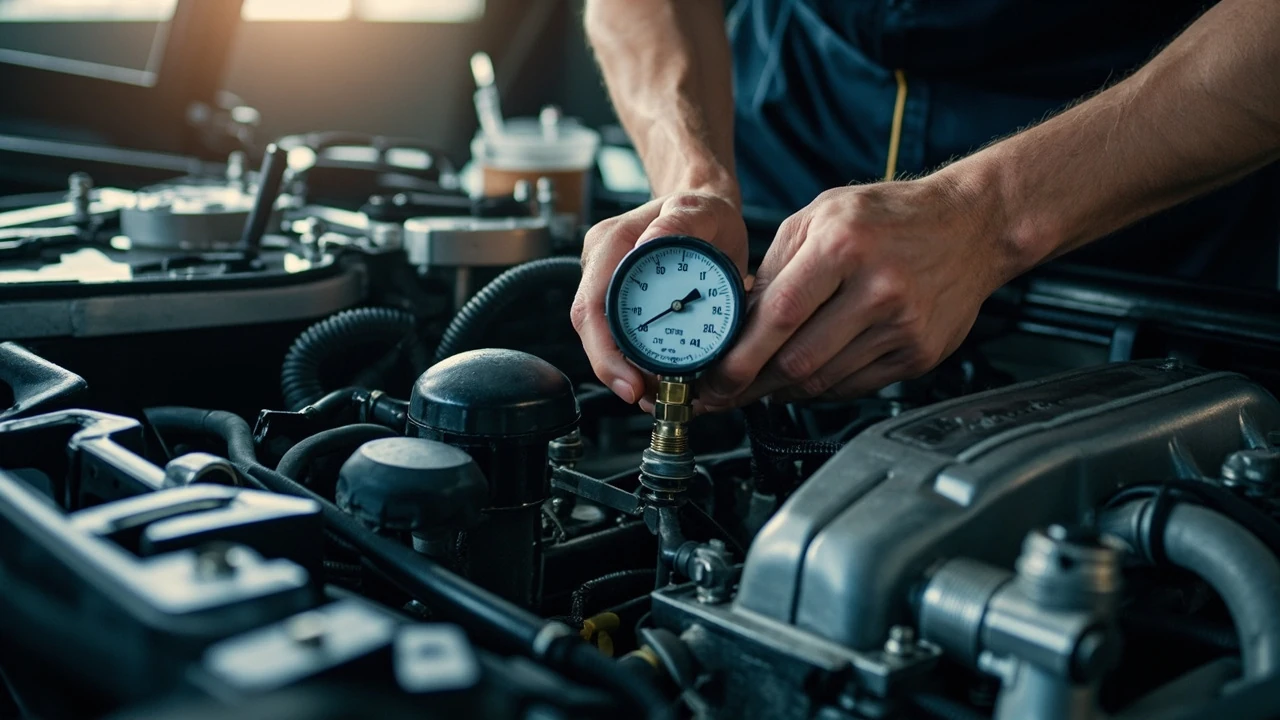
- Observe the gauge at idle and higher engine speed. On vehicles without a dependable gauge, a technician can connect a calibrated mechanical gauge or electronic pressure tester to the designated test port. The comparison is useful only when the connection is sealed and the engine is at the specified operating temperature.
- Test the pressure-sending unit and circuit. If the warning does not agree with engine noise, temperature, oil level, or other indications, the sensor, wiring, connector, or control module may be sending an incorrect signal.
- Inspect the oil flow path. The pickup, filter, galleries, and control valve may require inspection after the oil system is drained and opened. A clogged filter can be relatively easy to identify, while a restricted internal gallery may require substantially more disassembly.
- Evaluate the pump based on measured flow and pressure. A worn pump more commonly causes insufficient pressure. Restricted inlet flow, aerated oil, or a stuck control valve can mimic pump wear, so the pump should not be condemned from a warning message alone.
Temperature is central to the test. Cold oil is more viscous and offers greater resistance through small passages. Warm oil generally flows more easily. A pressure that is elevated only when cold may point toward oil specification, restricted flow, or cold-control behavior. A reading that becomes extremely high in both cold and warm conditions requires a more serious investigation.
Test equipment can produce misleading results when the fitting leaks, the wrong port is used, or the instrument is not calibrated. A leaking adapter may allow oil to escape and make the measured pressure appear lower than the pressure inside the engine. The gauge, sending unit, and electronic test method should also be understood as separate parts of the diagnostic process.
Modern vehicles may log oil pressure data, but a scan tool cannot replace a proper mechanical pressure test. Calibration errors, damaged wiring, and failed sensors can produce a warning without confirming excessive hydraulic pressure.
Common causes and the clues that separate them
The same dashboard message can come from a mechanical restriction, an oil-specification problem, a sensor fault, or internal engine damage. The behavior of the gauge and the condition of the oil help distinguish them.
| Possible cause | Typical clues | What it means | Usual correction |
|---|---|---|---|
| Stuck or faulty oil control valve | Pressure rises at low engine speed or during warm idle | The pump may be supplying oil, but excess pressure is not being controlled or relieved as designed. | Inspect the valve and related passages, replace the failed component if necessary, and verify pressure afterward. |
| Wrong or mixed oil viscosity | The cold reading is unusually high, often following an oil change | Oil that is thicker or incompatible with the engine can increase flow resistance. | Drain the engine, use the required specification, and repeat the pressure test under the prescribed conditions. |
| Restricted filter, pickup, or internal passage | Pumping noise, fluctuating pressure, or a change following recent service | Oil cannot circulate through its intended route, increasing resistance at a restricted point. | Remove and inspect the affected parts, correct the restriction, and confirm adequate oil flow. |
| Oil overfill | The level is above the maximum mark or the reading changed after oil was added | Excess oil may become aerated and produce unstable pressure behavior. | Bring the level into the specified range using the correct oil. |
| Faulty pressure sensor or sending unit | The warning conflicts with the engine’s behavior or other pressure indications | The vehicle may be reporting an electrical problem instead of excessive hydraulic pressure. | Test the circuit, connector, sensor resistance, and signal against service specifications. |
| Worn oil pump | Pressure falls at idle or under load, sometimes with a low-pressure warning | Insufficient flow can cause unstable lubrication or make the control system behave inconsistently. | Measure pump supply and regulated pressure, inspect the pump, and repair it as required. |
| Internal engine fault or combustion event | Coolant in the oil, oil in the coolant, rising oil level, or abnormal combustion | Engine damage may affect lubrication, while combustion gases can alter oil volume and aeration. | Perform cooling-system and compression tests, then inspect the engine for the underlying failure. |
The same general safety principle appears in industrial equipment. A For additional context, high-integrity overpressure protection system uses monitoring and shutoff components to stop a pressure source before equipment damage occurs. An engine does not use that industrial control architecture, but the distinction is useful: identifying the pressure source and the protective device is separate from confirming that the warning signal itself is accurate.
Overfilling is easy to overlook because some drivers treat every warning as a request for more oil. Excess oil can be churned into foam during startup. Foamed oil does not remain in the lubrication system consistently, and the reading may fluctuate as air separates from the oil. Continued operation can produce intermittent loss of lubrication at bearings, cam journals, and other components.
A failed filter, a filter installed backward where applicable, or a loose filter housing can also change oil flow. Do not use an unverified filter or bypass as a temporary repair. A mismatch may affect more than filtration, particularly in engines that use filter-housing regulators or pressure-regulated oil delivery.
Engine damage requires careful wording. A worn pump is a familiar cause of low oil pressure, so it should not automatically be blamed for a high reading. However, internal faults and combustion-related problems can produce erratic pressure, aeration, or changing oil levels. If coolant is present in the oil, the engine has a separate cooling-system failure that needs diagnosis. Understanding blown head gasket symptoms can help distinguish that condition from an ordinary oil-level change, but the repair decision still depends on direct testing.
Symptom patterns and likely areas to inspect
A useful diagnosis compares the pressure behavior with temperature, engine speed, oil level, noise, and recent service. The table below summarizes common patterns. It is a starting point for inspection, not a substitute for a calibrated pressure test.
| Observed pattern | Likely areas to inspect | Questions for the technician |
|---|---|---|
| Pressure is high at idle and normal or lower at road speed | Oil control valve, pressure regulator, restricted gallery, and pump delivery | Does the reading follow the manufacturer’s specified speed curve? |
| Warning appears when cold but clears after warming up | Oil viscosity, cold gallery restrictions, sending-unit calibration, and oil aeration | Was the engine filled with the required oil, and was the reading taken at the specified temperature? |
| Gauge rises sharply but does not return to a stable range | Stuck regulating valve, blocked filter, or fluctuating pump flow | Was the pressure recorded with a sealed mechanical gauge or a validated electronic tester? |
| Warning appears with a loud whine or pumping noise | Oil pickup, filter, relief valve, gallery, and oil level | Was the filter inspected, and does the oil reach the pickup without aeration? |
| Warning and overheating message appear together | Oil delivery, pump operation, coolant circulation, and internal engine damage | Has the cooling system and lubrication supply been tested separately? |
| Oil level rises or white smoke appears | Head gasket, cylinder head, combustion gases, and possible fuel dilution | Has the oil been tested for coolant and fuel contamination? |
Recent work can narrow the inspection. A pressure problem that starts after an oil change may point to the wrong viscosity, an incorrect filter, an improperly tightened housing, or overfilling. A problem following engine work may involve a disturbed oil line, a missed sealing washer, or debris left inside the lubrication system. Documenting the repair history is therefore more useful than simply noting the mileage.
What to do when the warning appears
If the oil-pressure light comes on, move to a safe location as soon as practical. Park on level ground, apply the parking brake, and shut off the engine. Allow the oil to settle for the interval specified in the owner’s manual before checking the dipstick. Do not remove engine components or open a hot cooling-system cap.
Use this sequence to reduce the risk of further damage:
- Stop driving and shut off the engine if the warning remains on or appears with knocking, overheating, heavy leakage, or a maximum gauge reading.
- Check the oil level only after following the manufacturer’s waiting and reading procedure.
- If the level is low, add the exact oil specification required by the owner’s manual. Do not add a large quantity to test whether the gauge changes.
- If the level is correct, arrange a pressure test and mechanical inspection rather than adding more oil.
- Do not run the engine continuously at high idle to see whether the warning clears. Repeated low-speed operation may circulate oil poorly and make the fault harder to diagnose.
Correct oil and a corrected level may resolve a low-pressure condition caused by inadequate supply, but they will not repair a blocked control valve, an overfilled engine, a faulty sensor, or a damaged oil gallery. If the oil level is within range and the warning remains, the vehicle needs a proper diagnosis.
Towing may be safer than driving when the gauge reaches maximum, the engine is overheating, or a confirmed lubrication fault is present. A passenger vehicle should not be driven at highway speed with this condition. Avoiding further operation is more important than the convenience of reaching a particular repair shop.
How oil pressure differs across engines
There is no universal pressure range for every car. The manufacturer may specify a minimum at a particular engine speed and oil temperature, and some vehicles do not include a conventional oil-pressure gauge. A passenger-car engine should not be compared directly with a heavy truck, a hybrid engine with electric assistance, or a performance engine that uses multiple pumps and greater flow capacity.
Conventional systems commonly use a belt-driven or engine-driven pump, a pressure regulator, an oil filter, and internal galleries. Some newer engines use electrically controlled pumps, multiple shutoff valves, or variable-displacement pumps to reduce pumping losses at lower loads. A system that reduces pump output is not necessarily the same as one designed to maintain a fixed pressure. Readings must be interpreted using the specifications for the exact vehicle.
The owner’s manual provides the first reference for oil viscosity, service intervals, gauge behavior, warning messages, and any pressure-test procedure. Manufacturer service information may include the correct test port, engine speed, oil temperature, and minimum acceptable pressure. After a repair, the system should be bled as required, the oil level checked, and the pressure verified under those specified conditions.
Electrical troubleshooting should not obscure the mechanical question. A warning lamp depends on the sending unit, wiring, and control logic. If the monitoring system is inaccurate, the oil-flow problem still needs to be tested with a verified instrument. Clearing an electronic code does not correct a restricted gallery or faulty regulator.
Preventing high oil pressure after repair
After the underlying fault is corrected, use the exact oil viscosity and required approvals for the engine. Record the date and mileage of each oil change. Match the filter to the engine and install it according to the manufacturer’s instructions. Check the oil level after the engine has settled and following the prescribed warm-up cycle.
Do not repeatedly top off an engine that is already correctly filled. If oil consumption increases, investigate the cause instead of treating a rising dipstick reading as routine maintenance. Coolant in the oil, coolant loss, white exhaust smoke, or a new mechanical noise also deserves prompt inspection.
Maintenance records can reveal whether the fault followed recent work. Note oil changes, filter replacement, repairs around the oil pan or valve cover, electrical work, severe cold operation, and any unusual noise. A clear timeline helps distinguish an incorrect oil choice from a sensor fault, restricted passage, or internal engine problem.
If the vehicle has a recurring pressure complaint, ask the repair facility to document the measured pressure, oil temperature, engine speed, oil specification, and test-port location. Those details make a follow-up inspection more reliable and reduce the chance of replacing parts without confirming the cause.
Frequently asked questions
Can I drive with high oil pressure?
Do not continue normal or highway driving while an oil-pressure warning is active. If the light appeared briefly during startup and the engine now runs quietly without leaks or overheating, pull over and check the oil level. If the warning remains, the gauge reaches maximum, or the engine knocks, overheats, or loses oil, shut it down and arrange towing or on-site diagnosis.
Is high oil pressure caused by too much oil?
It can be. Overfilling can aerate the oil, create unstable readings, and cause intermittent loss of lubrication as the foam separates. Other common causes include a restricted passage and a control valve that is not relieving pressure as intended. Check the level correctly, but do not assume adding more oil will solve the warning.
Why does my oil pressure go up when I rev the engine?
Some engines naturally produce more pressure as pump speed increases, so the gauge may rise during acceleration. If the reading enters an abnormal range or a warning appears, the control system may not be managing pressure as intended. A restriction can also make the response unusually high or erratic. Compare the behavior with the manufacturer’s specification and have the pressure tested under controlled conditions.
Why is the oil pressure light on but the oil level full?
A full oil level only confirms that the dipstick reading falls within the specified range. The warning may still come from a blocked oil passage, a faulty control valve, an inaccurate sending unit, damaged wiring, or aerated oil. A mechanical pressure test and an electrical check are needed to identify the actual cause.
Does high oil pressure mean the oil pump is bad?
Not necessarily. A worn pump is more often associated with insufficient pressure, particularly at idle or under load. A high reading frequently leads to the oil-control system rather than the pump itself. Measuring pump output and regulated system pressure helps separate those conditions.
Is high oil pressure related to engine overheating?
The conditions can occur together because a lubrication failure can cause heat, while other engine faults can affect both systems. Heat alone does not necessarily create excessive oil pressure because warm oil generally flows more easily. If the temperature and oil-pressure warnings illuminate simultaneously, stop driving and shut off the engine promptly.
Can overfilled oil damage the engine?
Yes. Excess oil can foam during startup, causing unstable pressure and intermittent loss of lubrication as air enters and leaves the oil. Continued operation can damage bearings, the valve train, and other components. Correct the level with the specified oil, then verify that the pressure warning has cleared and the reading remains within the expected range.
How do mechanics test oil pressure?
A technician usually connects a calibrated mechanical gauge or electronic pressure tester at the manufacturer’s designated test port. The engine runs under specified conditions while the reading is recorded at relevant engine speeds. The process may also check oil delivery, temperature, leaks, and the sending unit. The correct fitting and a sealed connection are essential for an accurate result.
Will changing the oil fix high oil pressure?
An oil change may help when the wrong viscosity, contaminated oil, or a restricted filter is responsible. It will not repair a stuck control valve, an obstructed internal gallery, a damaged pump, or a failed pressure sensor. Drain the engine, inspect the filter and oil condition, refill with the required specification, and verify the pressure afterward.
What should I do if the oil-pressure gauge reaches maximum?
Pull over safely, switch off the engine, and let it cool before checking the oil level. Do not continue driving to see whether the gauge returns to normal. If the reading remains high, the engine is leaking oil, or mechanical noise is present, arrange towing to a repair facility. Diagnosis with the engine stopped is safer than repeated driving.